If you’ve ever searched “how to grow your money in the stock market,” you’ve likely encountered two terms that get used almost interchangeably — trading and investing. They’re not the same thing. Confusing the two could mean taking on more risk than you intended, or missing out on the returns you’re actually looking for.
This guide breaks down the core differences between trading and investing in plain language — from time horizon and analysis methods to risk levels and tax implications — so you can make a more informed financial decision.
What Is Trading?
Trading is the active buying and selling of financial instruments — stocks, forex, commodities, cryptocurrencies, or derivatives — with the goal of making short-term profits from price fluctuations. Unlike long-term investing, traders don’t care much about a company’s five-year vision. They care about what the price is doing right now or this week.
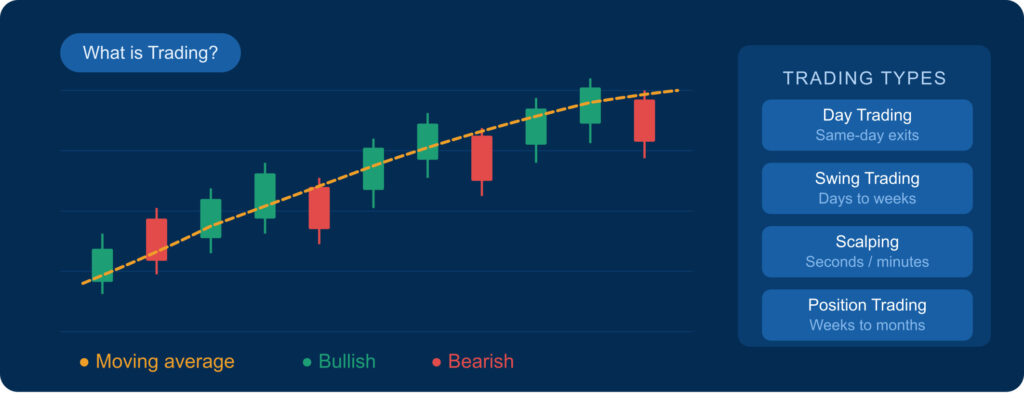
Traders rely heavily on technical analysis: reading price charts, identifying patterns, and using indicators like moving averages and volume to time their entries and exits.
Common Types of Trading
- Day Trading — Positions opened and closed within the same trading session. No overnight exposure.
- Swing Trading — Trades held for a few days to several weeks, targeting medium-term price momentum.
- Scalping — Ultra-short trades lasting seconds or minutes, profiting from tiny price movements.
- Position Trading — Longer than swing trading (weeks to months), but still shorter than traditional investing.
What Is Investing?
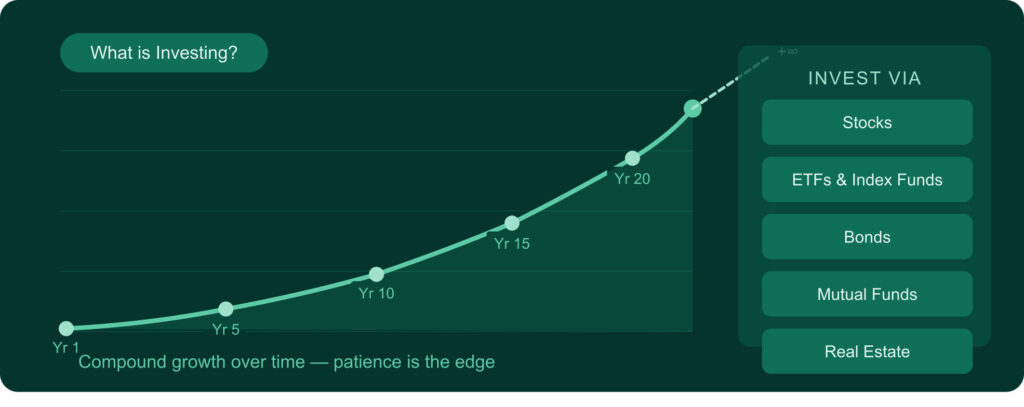
Investing is the practice of buying financial assets — shares, bonds, mutual funds, ETFs, or real estate — and holding them over a long period to build wealth through capital appreciation, dividends, or interest income.
Investors use fundamental analysis: studying a company’s earnings, revenue growth, debt levels, competitive moat, and the broader economic environment. The aim isn’t to beat yesterday’s price move — it’s to own a piece of something that grows in value over years or decades.
Think of Warren Buffett’s buy-and-hold approach. That’s investing in its purest form.
Common Investment Vehicles
- Stocks (long-term ownership)
- Bonds (steady income, lower volatility)
- Mutual Funds and ETFs (diversified, passive or active)
- Real Estate (appreciation plus rental income)
- Index Funds (low-cost, broad market exposure)
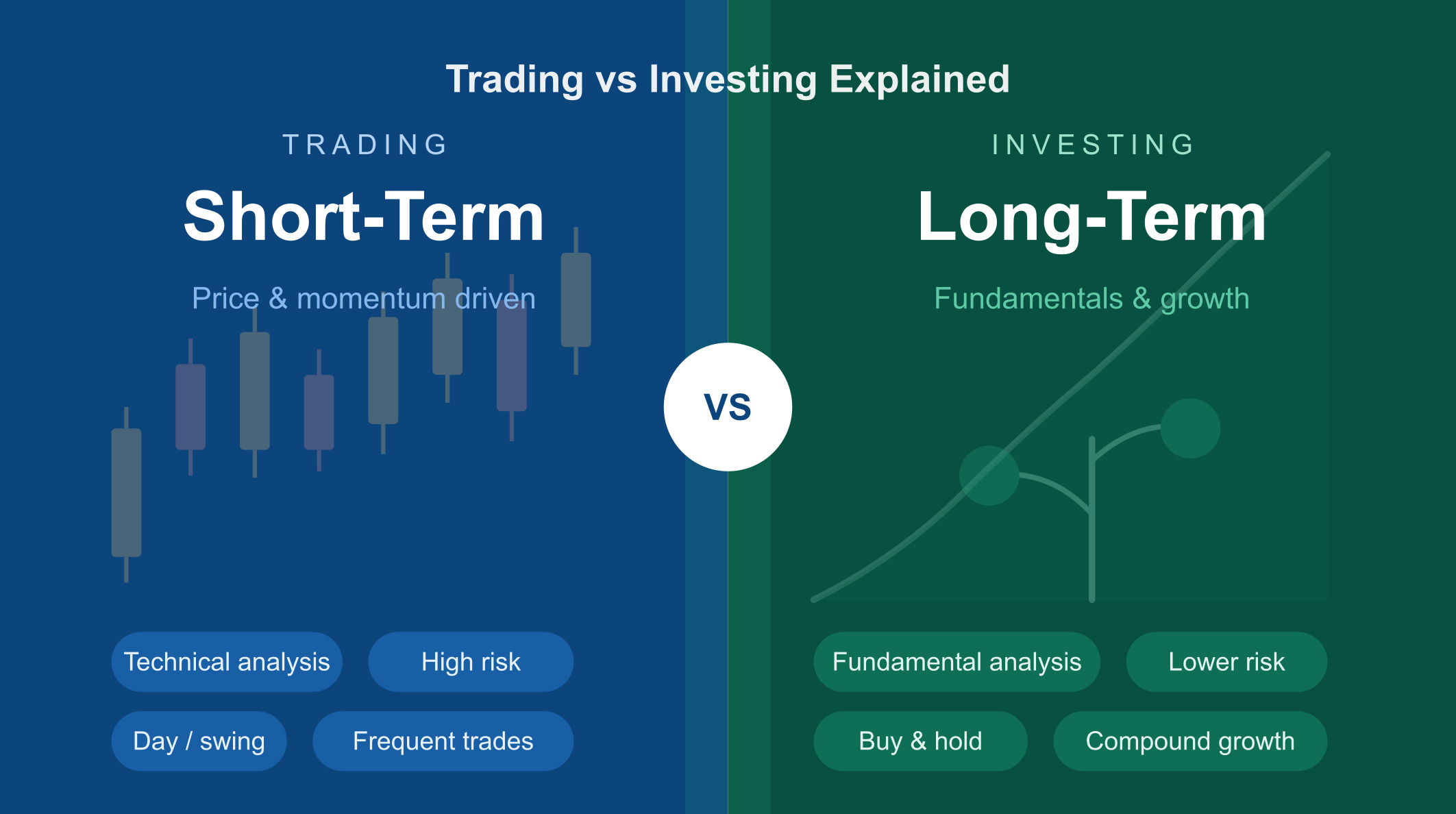
Trading vs. Investing: Key Differences at a Glance
| Feature | Trading | Investing |
|---|---|---|
| Time Horizon | Seconds to months | Years to decades |
| Primary Goal | Short-term price profit | Long-term wealth accumulation |
| Analysis Method | Technical analysis (charts, indicators) | Fundamental analysis (earnings, growth) |
| Risk Level | Higher (leveraged, volatile) | Lower (compounding, diversified) |
| Activity Level | Active, constant monitoring | Passive, periodic review |
| Asset Ownership | May not own the underlying asset (CFDs) | Full ownership of asset |
| Tax Treatment | Short-term capital gains (higher rate) | Long-term capital gains (lower rate) |
| Stress Level | High (fast decisions, losses compound quickly) | Lower (market dips are expected) |
| Common Tools | Stop-loss orders, leverage, derivatives | Dividend reinvestment, dollar-cost averaging |
Difference in Approach: Technical vs. Fundamental Analysis
One of the clearest distinctions between traders and investors lies in how they make decisions.
Traders study price action. They look at candlestick patterns, support and resistance levels, RSI, MACD, and trading volume. The underlying business could be losing money — as long as the chart says “buy,” a trader might enter a position.
Investors dig into the business itself. They ask: Is revenue growing? Is the profit margin healthy? Is management trustworthy? What does the competitive landscape look like? These are questions that take weeks to research properly — and the payoff is measured in years, not days.
Neither approach is superior by default. They serve different objectives.
Risk and Reward: Which Is Riskier?
Trading carries higher short-term risk for several reasons:
- Leverage amplifies both gains and losses
- Shorter time frames leave less room to recover from a bad position
- Transaction costs (commissions, spreads) eat into profits with high-frequency activity
- Emotional decision-making under pressure leads to poor exits
Investing is not risk-free either — markets crash, sectors decline, and companies fail. But long-term investors have time on their side. Historical data consistently shows that equity markets recover and grow over extended periods, allowing investors to ride out short-term volatility.
A SEBI study (India, 2023) found that the majority of individual traders in equity F&O segments incurred net losses, with many spending 15–50% of their trading profits on transaction costs alone. This underscores why disciplined risk management is non-negotiable for traders.
Tax Implications: Trading vs. Investing
Taxes are a significant — and often overlooked — difference between the two approaches.
In most jurisdictions (including the US):
- Short-term capital gains (assets held under 12 months) are taxed at your ordinary income rate — which can be as high as 37% for high earners.
- Long-term capital gains (assets held over 12 months) benefit from preferential rates — typically 0%, 15%, or 20% depending on your income bracket.
This means a trader who earns 20% in a year might net considerably less after taxes than an investor who earned 15% through buy-and-hold, simply because of how their gains are classified.
Tax-loss harvesting, tax-advantaged accounts (like IRAs and 401(k)s), and strategic asset placement can all reduce tax drag — but these tools are generally more naturally suited to investors than active traders.
Which One Is Right for You?
There’s no universal answer. The right approach depends on your personal goals, temperament, and available time.
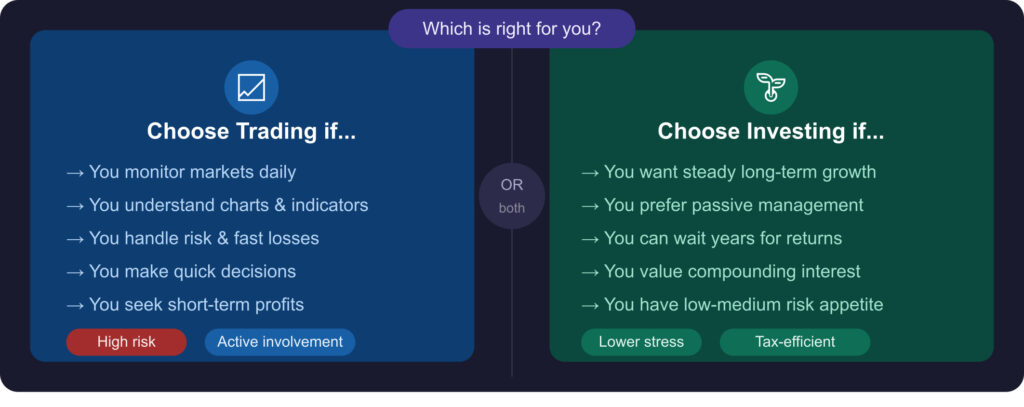
Consider investing if you:
- Are building wealth for retirement, education, or a long-term goal
- Don’t want to monitor charts daily
- Prefer lower stress and a more passive approach
- Want to benefit from compound growth over time
Consider trading if you:
- Have time to study markets and monitor positions regularly
- Are comfortable with higher risk and faster losses
- Understand technical analysis and risk management tools
- Can separate emotions from decision-making
Many experienced market participants actually do both — maintaining a core long-term investment portfolio while allocating a smaller portion of capital to short-term trades. The key is knowing why you’re in each position.
Can You Switch Between the Two?
Yes — and many people accidentally do this in ways that hurt them.
A classic trap: you enter a stock as a short-term trade, the price drops, and instead of cutting your loss, you tell yourself “I’ll just hold this long-term.” That’s not an investment strategy — that’s a failed trade being rationalized. The reverse happens too: an investor panics during a correction and sells, turning a long-term position into a short-term loss.
The fix is simple: define your strategy before you enter any position. Know your time horizon, your exit criteria, and your risk tolerance ahead of time.
Frequently Asked Questions
What is the main difference between trading and investing?
Trading aims to profit from short-term price movements, while investing focuses on building wealth over the long term through asset appreciation and income.
Is trading riskier than investing?
Yes, generally. Trading involves higher volatility, shorter time frames, and often leverage — all of which increase the potential for rapid losses.
Which analysis method do traders use?
Traders primarily use technical analysis — studying charts, price patterns, volume, and indicators to predict short-term price movements.
Which analysis method do investors use?
Investors rely on fundamental analysis — evaluating a company’s financial health, earnings growth, management quality, and industry trends.
Can I do both trading and investing at the same time?
Yes. Many people maintain a long-term investment portfolio while trading a smaller portion of their capital for short-term opportunities.
How does tax treatment differ between trading and investing?
Short-term trading profits are taxed at higher ordinary income rates, while long-term investment gains qualify for lower capital gains tax rates in most countries.
Which is better for beginners — trading or investing?
Investing is generally more suitable for beginners due to lower risk, less required monitoring, and the forgiving nature of long-term compounding.
What is the best strategy: “timing the market” or “time in the market”?
Research consistently favors “time in the market” (investing) over “timing the market” (trading) for the average person building long-term wealth.
Conclusion
Trading and investing are two distinct financial strategies — each with its own logic, tools, risk profile, and tax treatment. Trading offers the potential for fast profits but demands skill, discipline, and a high tolerance for risk. Investing rewards patience, consistency, and the ability to weather market cycles without panic.
Understanding which approach aligns with your financial goals, available time, and personality is more valuable than chasing the “better” option. For most people building long-term wealth, investing provides a more reliable path. For those who are deeply engaged with markets and willing to put in the work, trading can complement — but rarely replace — a solid investment foundation.
Whatever path you choose, start with clarity: know your goal, know your risk, and have a plan before you put a single dollar to work.
Disclaimer: This article is for educational purposes only and does not constitute financial advice. Always consult a licensed financial advisor before making investment or trading decisions.