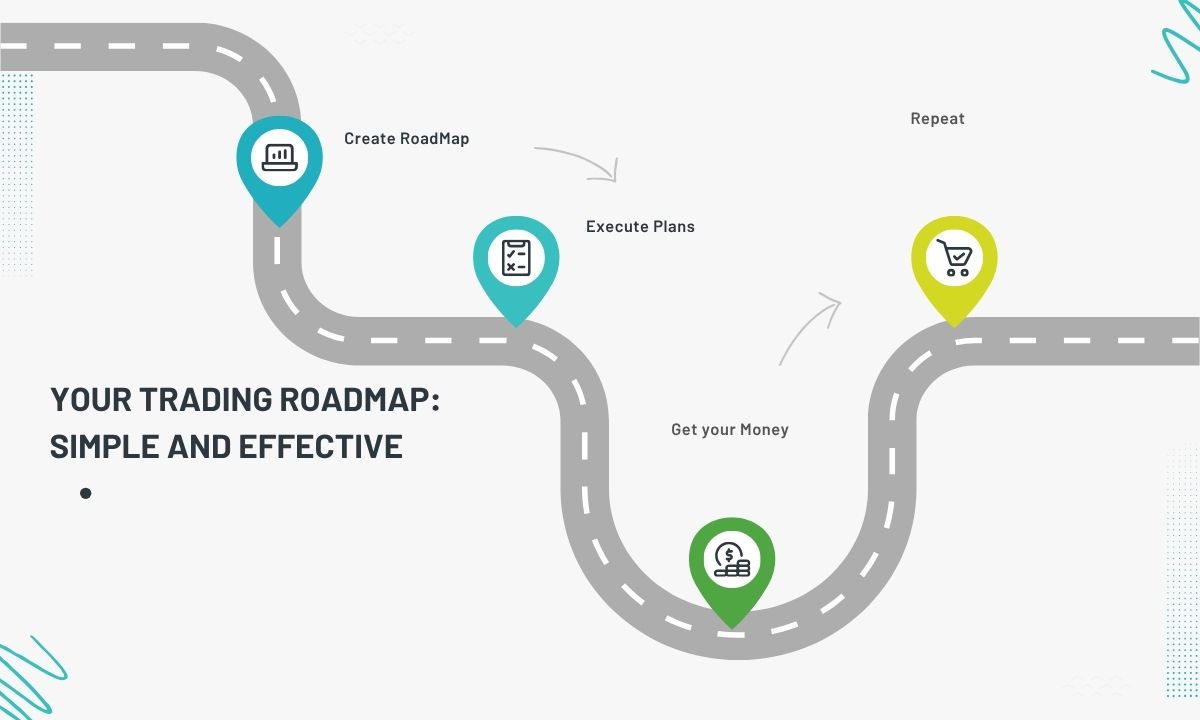
Your Trading Roadmap is the Most new traders dive into the markets with enthusiasm but no real plan. They watch a few YouTube videos, open a brokerage account, and start placing trades based on gut feeling — only to watch their capital slowly disappear. The pattern repeats endlessly, not because trading is impossible, but because they had no roadmap.
A trading roadmap is your structured, step-by-step guide through the financial markets. It replaces guesswork with clarity, impulse with process, and confusion with confidence. Whether you’re a complete beginner or a struggling trader looking to reset, this guide gives you a clean, practical path forward — from setting your first goal to becoming a consistently profitable market participant.
Understanding the Trading Roadmap
A trading roadmap is not a strategy. It’s bigger than that. It’s the entire framework that holds your strategy, your mindset, your risk rules, and your learning process together. Think of it as the foundation your trading career is built on.
Without it, even the best technical setup means nothing. With it, even an average strategy becomes sustainable. Here’s how to build yours — step by step.
Step 1: Set Clear Goals
Every successful trader starts with one question: Why am I trading?
The answer matters more than you think. Your “why” determines your time horizon, your risk tolerance, and the trading style that will actually suit your lifestyle. Be brutally specific:
- Vague goal: “I want to make money trading.”
- Clear goal: “I want to generate a consistent 10–15% annual return on a $10,000 account within 18 months.”
When setting your trading goals, consider:
| Goal Type | Example | Time Horizon |
|---|---|---|
| Supplemental income | Extra $500/month | Short to medium term |
| Wealth accumulation | Grow portfolio 15% annually | Long term |
| Full-time income | Replace 9–5 salary | 2–5 years |
| Capital preservation | Protect savings from inflation | Long term |
Realistic, measurable goals keep you grounded when the market tests your patience — and it will.
Step 2: Educate Yourself
Trading rewards knowledge and punishes ignorance. Before risking a single dollar, invest time in building a solid education foundation.
Core areas every trader must understand:
- Market basics — how exchanges work, order types, bid/ask spreads, liquidity
- Technical analysis — candlestick patterns, support and resistance, chart patterns, moving averages, RSI, MACD
- Fundamental analysis — earnings reports, economic indicators, interest rate decisions, news events
- Trading psychology — fear, greed, confirmation bias, overtrading, revenge trading
- Risk and money management — position sizing, stop-loss placement, risk-reward ratios
Recommended resources:
- Technical Analysis of the Financial Markets by John Murphy
- Trading in the Zone by Mark Douglas (essential for mindset)
- Market Wizards by Jack Schwager
- Free platforms: Investopedia, BabyPips (for forex beginners), TradingView’s educational section
Don’t try to learn everything at once. Choose one market — stocks, forex, or crypto — and master it before expanding.
Step 3: Choose the Right Trading Style
There is no universally “best” trading style. The best one is the one that fits your schedule, temperament, and financial situation.
| Trading Style | Holding Period | Time Required | Best For |
|---|---|---|---|
| Scalping | Seconds to minutes | Full-time attention | Experienced, fast-paced traders |
| Day Trading | Minutes to hours | Several hours daily | Active, focused traders |
| Swing Trading | Days to weeks | 1–2 hours daily | Part-time traders |
| Position Trading | Weeks to months | 30 mins/day | Busy professionals |
Ask yourself:
- Do you have 4–6 hours a day to monitor charts, or just 30 minutes in the evening?
- Can you handle the emotional swings of watching positions fluctuate minute by minute?
- How quickly do you need returns — or can you be patient?
Most beginners do best starting with swing trading. It gives you enough time to think before each trade, doesn’t require constant screen time, and the slightly slower pace helps you develop discipline without burning out.
Step 4: Develop a Risk Management Plan
This is the most important step in your trading roadmap. Many traders with mediocre strategies still survive and profit long-term — simply because their risk management is rock solid. The reverse is never true.
The non-negotiable rules:
- Risk only 1–2% of your total capital per trade. On a $5,000 account, that’s $50–$100 per trade. This ensures you can survive 30, 40, even 50 consecutive losing trades without blowing your account.
- Always use a stop-loss. Place it at a level that invalidates your trade idea — not based on how much money you’re willing to lose.
- Target a minimum 1:2 risk-reward ratio. Risk $1 to potentially make $2. At this ratio, you only need to be right 40% of the time to be profitable.
- Never average down on losing positions. Adding to a losing trade is one of the fastest ways to wipe an account.
- Set a daily loss limit. Many professional traders stop trading for the day after losing 2–3% of their account. This prevents emotional decision-making from compounding losses.
Risk management isn’t what you do after a loss — it’s what you build into every single trade before you enter.
Step 5: Analyze the Market
Before placing any trade, you need to understand what the market is doing — and why. There are two primary analytical frameworks:
Technical Analysis (TA) Focuses on price action, chart patterns, and indicators. You’re reading supply and demand as they reveal themselves on the chart. Key tools include:
- Support and resistance levels
- Trend lines and channels
- Candlestick patterns (pin bars, engulfing patterns, doji)
- Volume analysis
- Indicators: RSI, MACD, Bollinger Bands, EMA/SMA
Fundamental Analysis (FA) Focuses on the underlying drivers of an asset’s value — earnings, economic data, central bank policy, geopolitical events. More relevant for swing and position traders.
Most successful traders combine both. Use fundamental analysis to determine what to trade, and technical analysis to determine when to enter and exit.
Multi-timeframe analysis is also a powerful habit: check the weekly or daily chart for the big picture trend, then drop to the 4-hour or 1-hour chart to find a precise entry point.
Step 6: Create a Trading Plan
A trading plan is your written rulebook. It removes ambiguity and keeps emotion out of your decision-making process. Every trade you take should be justified by your plan — not by a “feeling” or a tip you read online.
Your trading plan should cover:
- Markets traded — Which assets? Which sessions?
- Trading style — Day trader, swing trader, etc.
- Entry criteria — What exact conditions must be met before you enter a trade?
- Exit criteria — Where is your stop-loss? Where is your take-profit?
- Position sizing rules — How much to risk per trade?
- Maximum daily/weekly drawdown — At what loss do you stop trading?
- Review schedule — How often do you evaluate and update the plan?
A plan that lives only in your head is not a plan. Write it down. Review it regularly. Treat it like a business document — because trading is a business.
Step 7: Keep a Trading Journal
Your trading journal is where your improvement actually happens. Without it, you’re flying blind. With it, you turn each trade — win or lose — into data that makes you sharper.
What to record in every entry:
- Date, time, and market traded
- Entry price, stop-loss, take-profit levels
- Direction (long or short)
- Reason for the trade (what was your setup?)
- Emotional state before, during, and after the trade
- Outcome and P&L
- What you would do differently
Review your journal weekly. Look for patterns: Do you lose more when you trade against the trend? Do you cut winners too early? Are you revenge trading after losses? The answers are all in the data — but only if you’re recording it.
Many experienced traders consider the trading journal the single highest-leverage activity in their development. It costs nothing except time, and the returns in self-awareness compound over months and years.
Step 8: Stay Disciplined and Patient
Discipline and patience are not personality traits — they’re skills you build through consistent habit and intentional practice.
The biggest enemies of a trader’s account are:
- FOMO (Fear of Missing Out) — jumping into trades late because you’re afraid of missing a move
- Revenge trading — taking impulsive positions after a loss to “win it back”
- Overtrading — placing too many trades, often out of boredom rather than genuine setups
- Moving stop-losses — hoping a losing trade will turn around
Every one of these behaviors is driven by emotion overriding process. The antidote is simple but not easy: follow your trading plan, every time, without exception.
Experienced traders often say: “The market will always be there tomorrow.” There is always another setup, another opportunity, another trade. Patience means waiting for the right ones.
Build a trading routine — specific hours for analysis, specific hours for trading, specific hours for review. Routine eliminates the mental overhead that leads to emotional decisions.
Step 9: Continuously Learn and Adapt
Markets evolve. Economic conditions shift. Volatility expands and contracts. A strategy that worked perfectly in 2022’s trending forex market may underperform in a choppy 2025 environment. The best traders don’t just learn once — they treat education as an ongoing professional obligation.
How to stay sharp:
- Backtest your strategies regularly against historical data to verify their edge is still intact
- Forward test in a demo account before applying changes to your live account
- Study your losing trades as carefully as your winners — most lessons live in the losses
- Follow credible market analysts and traders — not to copy their trades, but to expand your perspectives
- Join trading communities — forums and groups expose you to different market conditions and analysis frameworks
- Read widely — books on trading psychology, macroeconomics, and market history all sharpen your edge
The traders who last are not the most gifted — they’re the most adaptable. They treat every market phase, every losing streak, and every blown stop as information. Not failure. Data.
Conclusion
A trading roadmap doesn’t guarantee profits. Nothing does. What it guarantees is structure — and in trading, structure is the difference between a gambler and a professional.
The nine steps laid out here — from goal-setting and education to journaling and continuous improvement — are not just theory. They’re the foundational habits that every consistently profitable trader, at every level, practices in some form.
Start at Step 1. Don’t skip steps because they feel too basic. The traders who blow up their accounts almost always skipped Step 4 (risk management) or Step 6 (trading plan), not because they didn’t know those things existed, but because they were in a rush to get to the exciting parts.
Build the roadmap first. The profits follow the process.
Disclaimer: This article is for educational and informational purposes only. It does not constitute financial advice. Always consult a qualified financial professional before making trading or investment decisions.