The foreign exchange market — commonly known as forex or FX — is the beating heart of global finance. Every time a business pays an overseas supplier, a traveler converts currency at an airport, or a central bank intervenes to stabilize its economy, the forex market is at work. With trillions of dollars changing hands every single day, understanding how this market functions is essential for investors, traders, and anyone curious about the global economy.
What Is the Forex Market?
The foreign exchange market (forex) is a decentralized, over-the-counter (OTC) global marketplace where currencies are bought, sold, and exchanged. Unlike stock exchanges, there is no central trading floor — instead, transactions occur electronically between participants across time zones, 24 hours a day, five days a week.
Participants include commercial banks, central banks, investment firms, hedge funds, multinational corporations, and retail traders. Together, they determine the exchange rates that govern international commerce and investment.
Currencies are always quoted in pairs — for example, EUR/USD or GBP/JPY — because buying one currency always means simultaneously selling another. The relative value of each currency in the pair fluctuates based on supply and demand, economic data, interest rates, and geopolitical events.
Key Takeaways
- The forex market is the largest and most liquid financial market in the world.
- It operates 24 hours a day, 5 days a week across global financial centers.
- Currency pairs are the fundamental trading units; major pairs include EUR/USD, USD/JPY, and GBP/USD.
- Market participants range from central banks and commercial institutions to individual retail traders.
- The forex market serves critical functions including currency conversion, hedging, speculation, and price discovery.
Exploring the Basics of the Forex Market
$7.5 Trillion+
That’s the estimated average daily trading volume of the forex market, making it the largest financial market on earth — dwarfing even global equity markets. According to recent BIS Triennial Survey data, forex swaps account for the largest share of daily volume, followed by spot trades and outright forwards.
Forex trading is built around a few foundational concepts:
- Currency Pairs: Every trade involves two currencies. The first is the base currency, and the second is the quote currency. If EUR/USD = 1.10, one euro buys 1.10 US dollars.
- Pips: The smallest standard price movement in a currency pair, usually the fourth decimal place.
- Bid/Ask Spread: The difference between the buying and selling price — this is how brokers earn their fees.
- Lot Size: Standard lots are 100,000 units of the base currency. Mini (10,000) and micro (1,000) lots are also available for retail traders.
- Liquidity: The forex market’s enormous size ensures tight spreads and easy order execution, especially for major pairs.
Major currency pairs — those paired with the US dollar — account for the majority of all forex trading volume. The USD/EUR, USD/JPY, and USD/GBP are the most actively traded pairs globally.
Leverage in Forex: Risks and Opportunities
Leverage is one of the defining — and most double-edged — features of forex trading. It allows traders to control a large position with a relatively small amount of capital. For example, a 50:1 leverage ratio means a $1,000 deposit can control a $50,000 position.
How leverage amplifies outcomes:
| Leverage Ratio | Deposit Required | Position Size | 1% Gain Equals | 1% Loss Equals |
|---|---|---|---|---|
| 10:1 | $1,000 | $10,000 | $100 (+10%) | -$100 (-10%) |
| 50:1 | $1,000 | $50,000 | $500 (+50%) | -$500 (-50%) |
| 100:1 | $1,000 | $100,000 | $1,000 (+100%) | -$1,000 (-100%) |
While leverage can dramatically magnify gains, it equally magnifies losses. Regulatory bodies in many countries now cap leverage for retail traders — for example, the EU caps it at 30:1 for major pairs. Studies consistently show that the majority of retail forex traders lose money, partly because of improper leverage use.
Risk management tools like stop-loss orders, position sizing, and proper account management are essential when trading with leverage.
Different Types of Forex Markets Explained
The forex market is not a single entity — it’s made up of several interconnected market structures:
1. Spot Market The most widely used market, where currencies are traded for immediate delivery (usually within two business days). The spot rate is the current exchange rate for a currency pair. Most retail traders operate in the spot market.
2. Forward Market Customized contracts between two parties to exchange currencies at a pre-agreed rate on a specific future date. Forwards are OTC instruments used primarily by corporations and financial institutions for hedging against currency risk.
3. Futures Market Similar to forwards, but standardized and traded on regulated exchanges (like the CME). Futures contracts have fixed contract sizes, settlement dates, and are marked to market daily.
4. Options Market Currency options grant the buyer the right, but not the obligation, to exchange currency at a specified rate before a set expiration date. They’re used for both hedging and speculation.
5. Swap Market Forex swaps — the simultaneous buying and selling of a currency for two different value dates — represent the single largest segment of forex market volume, heavily used by banks and institutions for liquidity management.
Pros and Cons of Trading in Forex
Advantages
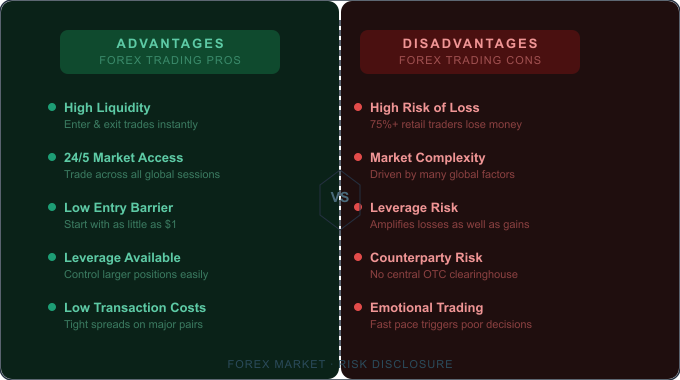
- Unmatched Liquidity: The sheer size of the forex market means you can enter and exit positions almost instantly at competitive prices.
- 24-Hour Access: Forex trading runs from Monday morning in Sydney to Friday afternoon in New York, giving traders flexibility across time zones.
- Low Entry Barrier: Many brokers allow accounts to be opened with as little as $1, with demo accounts freely available.
- Diverse Trading Opportunities: Dozens of currency pairs are available, from major pairs to exotic currencies, providing exposure to global economies.
- Leverage Availability: While risky, leverage allows traders to access larger market positions with limited capital.
- Low Transaction Costs: Forex spreads are among the tightest in financial markets, especially for major pairs.
Disadvantages
- High Risk of Loss: Studies show the majority of retail forex traders lose money, particularly those using high leverage.
- Market Complexity: Forex prices are influenced by a wide range of factors — interest rates, inflation, political events, and central bank policy — making consistent prediction difficult.
- Counterparty Risk: In the OTC market, there’s no central clearinghouse, meaning you rely on your broker’s solvency.
- Emotional Trading Pitfalls: The fast-moving, leveraged nature of forex makes it easy for emotions to override rational decision-making.
- Regulatory Variation: Forex regulation varies widely by country, and some jurisdictions offer weak investor protections.
The Historical Evolution of the Forex Market
The forex market has roots stretching back centuries:
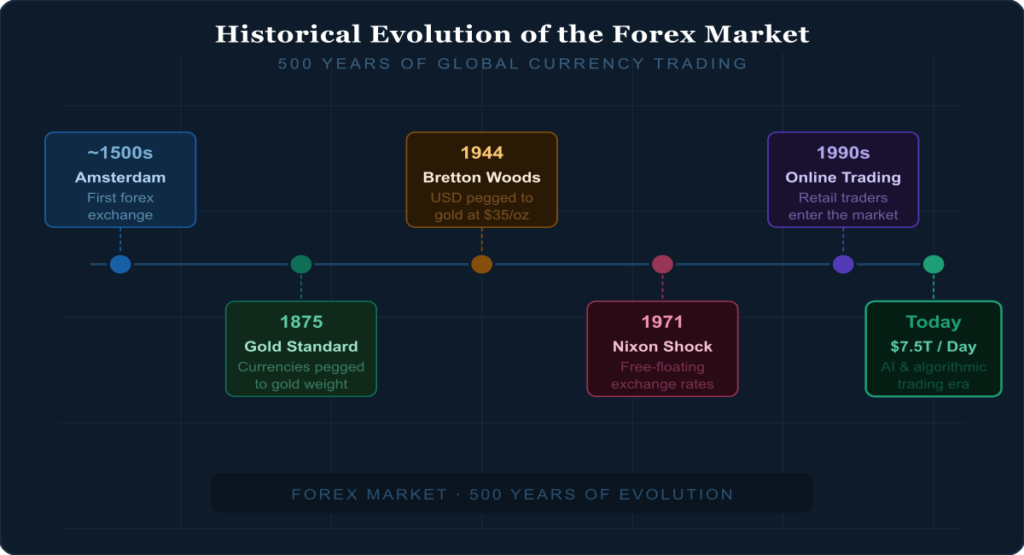
- ~500 years ago: The first recognizable currency exchange emerged in Amsterdam, where merchants traded currencies to stabilize exchange rates for international commerce.
- 1875 — Gold Standard: Countries adopted the gold standard, pegging their currencies to a fixed weight of gold. This provided stability but limited monetary flexibility.
- 1944 — Bretton Woods System: Following World War II, 44 nations agreed to peg their currencies to the US dollar, which was itself pegged to gold at $35 per ounce. This system established the USD as the world’s reserve currency.
- 1971 — Nixon Shock: US President Nixon ended the dollar’s convertibility to gold, effectively dismantling Bretton Woods. The world shifted to a free-floating exchange rate system.
- 1970s–1980s: Electronic trading systems began to emerge, democratizing access and increasing market efficiency.
- 1990s–2000s: The rise of the internet and online retail brokers opened the forex market to millions of individual traders worldwide.
- Today: Algorithms, AI-driven trading systems, and mobile platforms dominate retail forex, while institutional players continue to drive the majority of volume.
What Are the Types of Foreign Exchange Markets?
Foreign exchange markets can be categorized in two primary ways:
By Instrument:
- Spot transactions
- Outright forwards
- FX swaps
- Currency options
- Currency futures
By Participant:
- Interbank market (major global banks trading with each other)
- Retail market (individual traders via brokers)
- Institutional market (hedge funds, asset managers, pension funds)
- Central bank market (government interventions and reserve management)
Each segment operates with different rules, participants, and purposes, yet all contribute to overall price discovery and liquidity.
What Are the Functions of Foreign Exchange?
The forex market serves several critical economic functions:
- Currency Conversion: It enables businesses and individuals to convert one currency into another for international trade, travel, and investment.
- Price Discovery: The constant interaction of buyers and sellers establishes real-time exchange rates that reflect current economic conditions.
- Hedging: Corporations use forwards and options to lock in exchange rates and protect against adverse currency movements on future transactions.
- Speculation: Traders attempt to profit from anticipated currency movements, which adds liquidity and depth to the market.
- Arbitrage: Simultaneous buying and selling across markets helps correct pricing inefficiencies, keeping exchange rates consistent globally.
- Facilitating International Trade & Investment: Importers, exporters, and foreign investors all depend on efficient currency exchange to conduct cross-border business.
What Is the Importance of the Foreign Exchange Market?
The forex market is far more than a trading arena — it is the infrastructure of the global economy.
For governments and central banks, it is the mechanism through which monetary policy is transmitted internationally. Central banks use forex reserves and market interventions to manage inflation, support exports, and maintain financial stability.
For businesses, it enables the smooth execution of cross-border trade and investment, allowing companies to operate globally without being crippled by currency uncertainty.
For developing economies, a functional forex market attracts foreign investment, stabilizes import costs, and supports growth by integrating local currencies into the global financial system.
For individual investors and traders, it offers an accessible, liquid market to diversify portfolios and express views on macroeconomic trends.
Without a well-functioning foreign exchange market, international commerce as we know it would grind to a halt.
The Bottom Line
The forex market is the world’s largest, most liquid, and most accessible financial marketplace. It underpins global trade, enables cross-border investment, and provides opportunities for both institutional and retail participants to profit from currency movements. However, its complexity, leverage-driven risk, and the statistical reality that most retail traders lose money mean that success requires education, discipline, and sound risk management.
Whether you’re a business hedging currency exposure, an investor diversifying internationally, or a trader seeking market opportunities, understanding the forex market’s structure, history, and mechanics is the essential first step.
Frequently Asked Questions (FAQs)
What is the forex market in simple terms? The forex market is a global, decentralized marketplace where currencies are bought and sold. It determines the exchange rates between the world’s currencies.
How large is the forex market? The forex market processes over $7.5 trillion in average daily trading volume, making it the largest financial market in the world.
Can beginners trade forex? Yes, but beginners should start with a demo account, learn risk management, and only trade with capital they can afford to lose.
What moves forex prices? Interest rate decisions, inflation data, GDP reports, geopolitical events, and central bank policies are the primary drivers of currency price movements.
What is the best time to trade forex? The London–New York overlap (approximately 8 AM–12 PM EST) is generally considered the most liquid and active trading window.
Is forex trading legal? Yes, forex trading is legal in most countries, though regulation varies. Always use a regulated broker in your jurisdiction.
What is a pip in forex? A pip is the smallest standard price increment in a currency pair, typically the fourth decimal place (e.g., 0.0001 for EUR/USD).
One Comment