If you’ve ever glanced at a trading platform and wondered what “EUR/USD = 1.0850” actually means, you’re not alone. Reading forex currency pairs is the first skill every trader must master — and it’s simpler than it looks once you break it down.
This guide covers everything from the basics of forex quotes to bid/ask prices, spreads, and the difference between major and minor pairs. Whether you’re a complete beginner or brushing up before placing your first trade, this is the reference you need.
What are Forex Quotes?
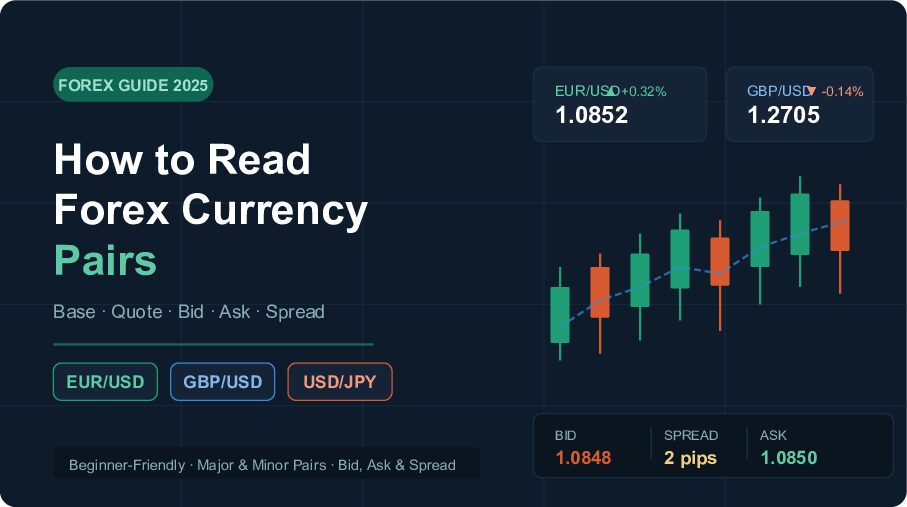
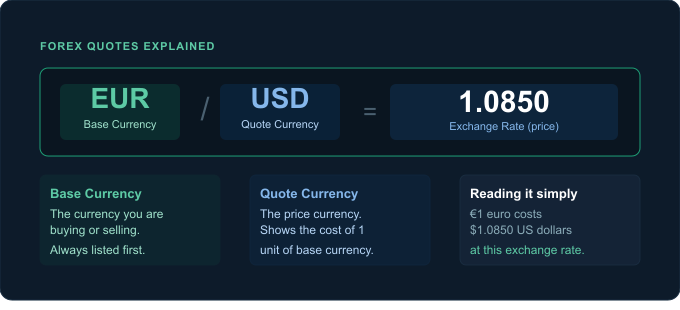
A forex quote is simply the price of one currency expressed in terms of another. Since currencies don’t exist in isolation on the forex market, they’re always paired together. When you check a quote like EUR/USD = 1.0850, you’re seeing how many US dollars it costs to buy one euro.
Every FX quote has two parts:
• Base currency — the first currency in the pair (e.g., EUR in EUR/USD)
• Quote currency (also called counter currency) — the second currency in the pair (e.g., USD in EUR/USD)
The price shown tells you how much of the quote currency you need to purchase one unit of the base currency. So if EUR/USD = 1.0850, you need $1.0850 to buy €1.
How do Forex Pairs Work?
When you trade a currency pair, you’re simultaneously buying one currency and selling the other. This is what makes forex unique compared to other markets.
Take EUR/USD as an example:
• Going long (buying) the pair means you’re buying euros and selling US dollars — you believe the euro will strengthen.
• Going short (selling) the pair means you’re selling euros and buying US dollars — you expect the euro to weaken.
You never need to place two separate orders. Your broker handles both sides of the transaction automatically. All you decide is direction: long or short.
Exchange rates are constantly in motion. They shift based on economic data releases, central bank interest rate decisions, inflation metrics, geopolitical events, and market sentiment. No rate is ever fixed — the forex market is live 24 hours a day, five days a week.
How to Read FX Rates?
Reading an FX rate comes down to understanding the base/quote structure. Here’s a quick example: GBP/USD = 1.2700. This means 1 British pound buys 1.27 US dollars. If this rate rises to 1.2900, the pound has strengthened against the dollar. If it drops to 1.2500, the pound has weakened.
Price movements in forex are tracked in pips — the smallest standard unit of price change. For most pairs, one pip equals a move of 0.0001 (the fourth decimal place). For JPY pairs, a pip is the second decimal place (0.01).
| Pair | Example Rate | Pip Value |
| EUR/USD | 1.0855 | 0.0001 |
| USD/JPY | 154.30 | 0.01 |
| GBP/USD | 1.2705 | 0.0001 |
| USD/CHF | 0.9010 | 0.0001 |
When you see a five-decimal quote like 1.08553, the last digit is a pipette (a fractional pip), giving brokers more pricing precision.
Bid and Ask Price
On any trading platform, you’ll notice that currency pairs show two prices, not one. These are the bid and ask prices, and understanding them is essential before you place a single trade.
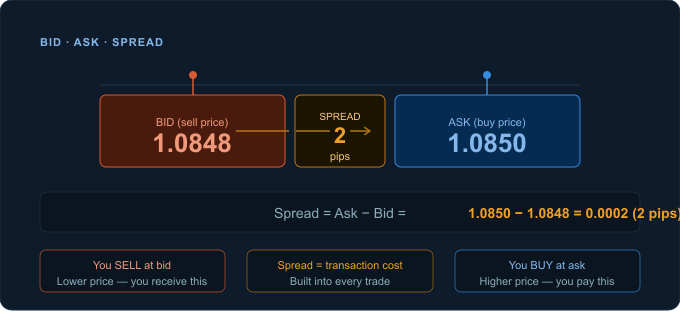
• Bid price — the price at which you can sell the base currency. This is always the lower of the two prices.
• Ask price — the price at which you can buy the base currency. This is always the higher of the two prices.
Example: EUR/USD: Bid = 1.0848 / Ask = 1.0850
If you want to buy EUR/USD, you pay the ask price of 1.0850. If you want to sell, you receive the bid price of 1.0848. Both prices update in real-time as market conditions change.
Spread
The spread is the difference between the ask price and the bid price. It’s measured in pips and represents your primary transaction cost when trading forex — even if your broker charges zero commission.
Spread = Ask Price – Bid Price
Using the example above: 1.0850 – 1.0848 = 0.0002 (2 pips). The moment you open a trade, you’re already 2 pips “in the red” because you bought at the ask but can only sell at the lower bid. The market needs to move in your favor by at least the spread amount before you break even.
Spreads can be fixed or variable (floating):
• Fixed spreads stay the same regardless of market conditions — useful for planning trade costs.
• Variable spreads widen during volatility and narrow during high-liquidity sessions. The tightest spreads are typically found during the London–New York overlap (roughly 8:00– 12:00 GMT), when trading activity peaks.
Why are the Bid and the Ask Prices Different?
The gap between bid and ask exists because the forex market isn’t a perfect two-way system — it runs through market makers and brokers who need compensation for facilitating trades and managing risk.
Several factors determine how wide or narrow the spread becomes:
1. Liquidity
Pairs like EUR/USD trade trillions of dollars daily, so there’s fierce competition among market makers, leading to very tight spreads. Exotic pairs trade far less frequently, which pushes spreads wider.
2. Volatility
During high-impact events — major central bank announcements, NFP releases, geopolitical shocks — uncertainty increases and market makers widen spreads to protect themselves.
3. Time of Day
Spreads tighten during peak sessions (London and New York overlap) and widen during quieter periods like the late New York session or early Asian session.
4. Pair Type
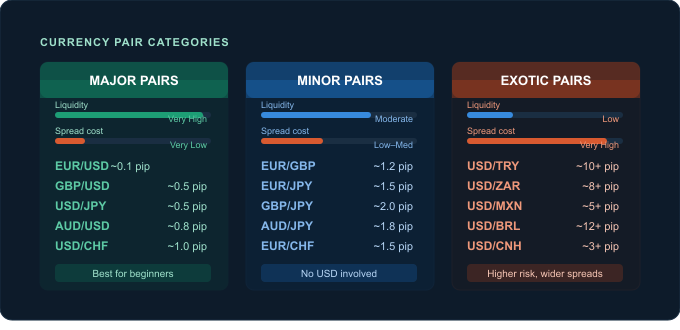
Major pairs carry the tightest spreads. Minor pairs are slightly wider, and exotic pairs can have spreads many times larger than majors.
Major and Minor Currency Pairs
Not all currency pairs are created equal. The forex market organizes pairs into three broad categories based on trading volume and liquidity.
Major Currency Pairs
Major forex pairs all include the US dollar paired with another major currency from developed economies. They dominate the forex market due to their high liquidity, tight spreads, and consistent trading volume.
| Pair | Nickname | Currencies |
| EUR/USD | Fiber | Euro / US Dollar |
| GBP/USD | Cable | British Pound / US Dollar |
| USD/JPY | Gopher | US Dollar / Japanese Yen |
| USD/CHF | Swissie | US Dollar / Swiss Franc |
| AUD/USD | Aussie | Australian Dollar / US Dollar |
| USD/CAD | Loonie | US Dollar / Canadian Dollar |
| NZD/USD | Kiwi | New Zealand Dollar / US Dollar |
Minor Currency Pairs (Cross Pairs)
Minor currency pairs, also called cross currency pairs, are combinations of major currencies that don’t include the US Dollar. They offer valuable diversification, alternative trading opportunities, and unique market behaviors. Examples include EUR/GBP, EUR/JPY, GBP/JPY, and AUD/JPY.
Exotic Currency Pairs
Exotic currency pairs consist of one major currency and the currency of a smaller or emerging economy, like South Africa, Turkey, or Brazil. They’re less liquid, have wider spreads, and often experience sharper price movements compared to major and minor pairs.
Direct vs Indirect FX Quotes
How a currency pair is quoted depends on which currency is being used as the reference point. Direct Quote
A direct quote expresses how much of the domestic currency is needed to buy one unit of a foreign currency. For a US-based trader, USD/JPY is a direct quote — it shows how many yen one dollar buys.
Indirect Quote
An indirect quote expresses how much foreign currency is needed to buy one unit of the domestic currency. EUR/USD is an indirect quote for a US-based trader — it shows how many dollars one euro costs.
| Quote Type | Example | Interpretation |
| Direct (for USD trader) | USD/JPY = 154.30 | $1 buys ¥154.30 |
| Indirect (for USD trader) | EUR/USD = 1.0850 | €1 costs $1.0850 |
In practice, most platforms display pairs in a standardized format, so you rarely need to switch between the two. However, understanding the distinction helps when analyzing cross-currency movements or comparing broker quotes.
Key Points
• A forex pair consists of a base currency and a quote currency
• The exchange rate shows how much of the quote currency buys one unit of the base • Buying a pair means buying the base and selling the quote; selling reverses this • The bid is your selling price; the ask is your buying price
• The spread = Ask – Bid, and represents your transaction cost
• Major pairs include the USD and offer the tightest spreads and highest liquidity • Minor pairs exclude the USD but still involve leading currencies
• Exotic pairs combine a major currency with one from an emerging market • Direct quotes price the domestic currency; indirect quotes price the foreign currency • Spreads widen during volatility, news events, and off-peak trading hours
Conclusion
Reading forex currency pairs isn’t complicated once you understand the structure. Every pair tells a story: which currency is the base, how much it’s worth relative to another, and what it costs you to trade. From the bid-ask spread to the difference between majors and exotics, these fundamentals shape every decision you make in the market.
Start with major pairs like EUR/USD or GBP/USD. They’re the most liquid, the most analyzed, and the most forgiving for new traders learning the ropes. As your confidence grows, you can
explore minors and exotics — but always with a clear picture of the liquidity and spread conditions involved.
The forex market is the largest financial market on Earth. Understanding how to read its language is your first step to navigating it with confidence.
FAQ
1. Which currency pair did the best?
EUR/USD has historically been the most consistently traded pair, but performance varies by year and market conditions. Always check current data before comparing pair performance.
2. What are the major currency pairs?
The seven major pairs are EUR/USD, GBP/USD, USD/JPY, USD/CHF, AUD/USD, USD/CAD, and NZD/USD — all include the US dollar paired with another leading global currency.
3. How do you define forex pairs?
A forex pair is two currencies quoted against each other, showing the price of the base currency in terms of the quote currency (e.g., EUR/USD = 1.0850 means €1 costs $1.0850).
4. What is the easiest forex pair to trade?
EUR/USD is widely considered the easiest pair for beginners due to its high liquidity, tight spreads, and abundance of analysis and educational resources available.
5. Which currency pair is most profitable in Forex?
There’s no single most profitable pair — profitability depends on your strategy, risk management, and market conditions. Major pairs like EUR/USD and GBP/USD offer consistent opportunities.
6. What is the safest currency in the world?
The Swiss franc (CHF) is widely regarded as one of the world’s safest currencies due to Switzerland’s political neutrality, strong banking system, and low inflation — making USD/CHF a popular safe-haven pair.