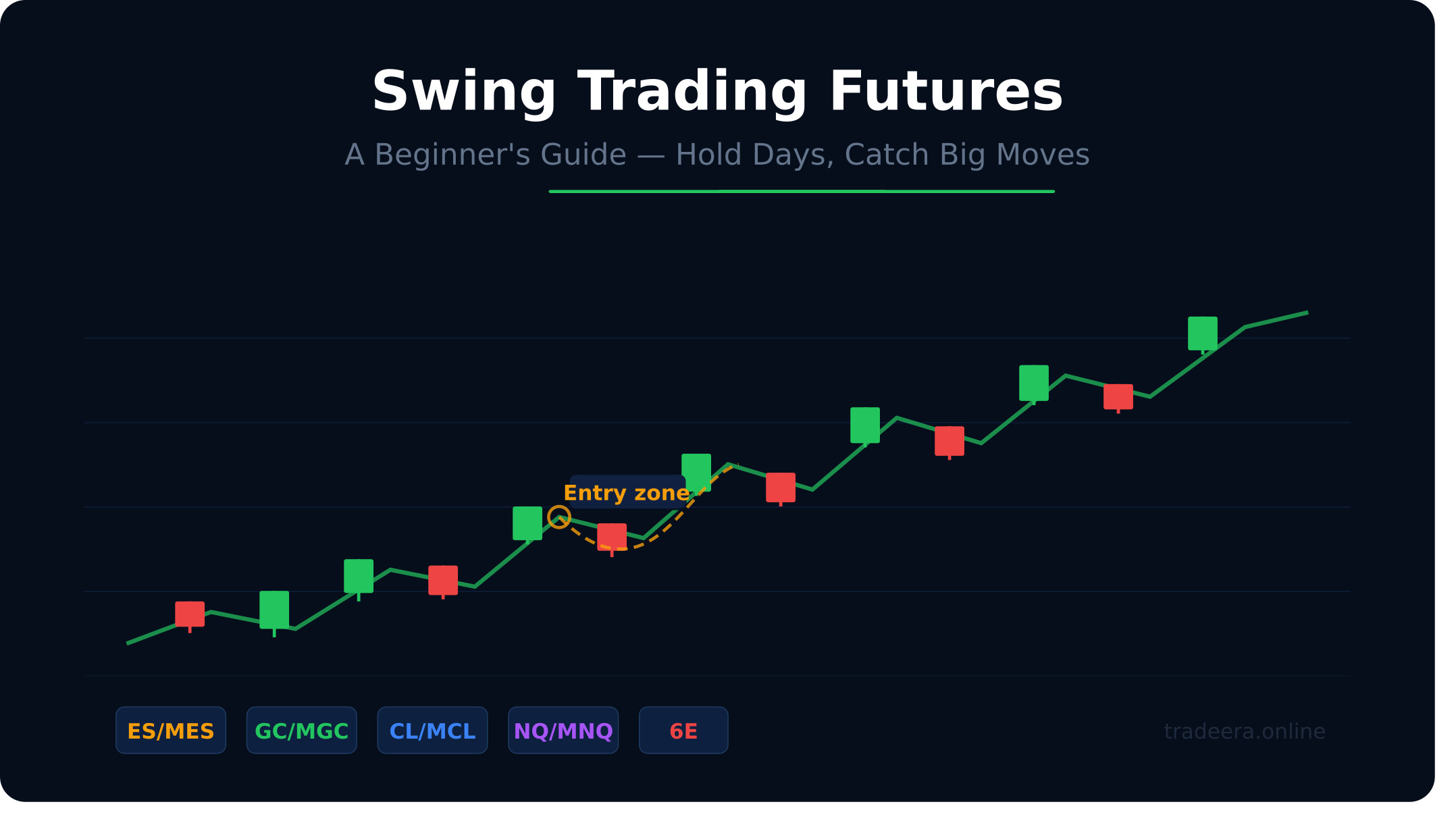
Most new traders assume futures trading means staring at screens all day, reacting to every tick. Swing trading futures turns that assumption completely upside down.
Swing trading is a medium-term strategy where you hold futures positions for several days rather than minutes or hours. It gives you time to think, plan, and execute without the relentless pressure of day trading. For anyone juggling a job, family, or other commitments — swing trading futures offers a genuinely practical path into the futures markets.
This beginner’s guide covers exactly how it works, which contracts to trade, the best strategies to start with, and how to manage risk effectively.
Key Takeaways
- Swing trading futures means holding positions for two to ten days to capture multi-day price moves
- It requires less screen time than day trading and suits part-time traders
- Micro futures contracts like MES and MNQ make swing trading accessible with lower capital requirements
- Overnight margin requirements are higher than intraday margins — budget accordingly
- Risk management and a clear trading plan are non-negotiable for consistent results
Why Swing Trade Futures?
Futures markets are uniquely well-suited to swing trading for several important reasons.
First, futures trade nearly 24 hours a day — Sunday through Friday. This means you can analyse markets in the evening, place trades outside regular stock market hours, and manage positions flexibly around your schedule.
Second, futures offer built-in leverage. A relatively small margin deposit controls a large notional position, which means even moderate price swings can produce meaningful returns. That same leverage, however, also amplifies losses — which is exactly why disciplined risk management is central to everything in this guide.
Third, the introduction of micro futures contracts — such as the Micro E-mini S&P 500 (MES) and Micro Nasdaq (MNQ) — has made swing trading accessible to traders with smaller accounts. These contracts are one-tenth the size of standard contracts, giving beginners a lower-risk entry point into professional futures markets.
How Swing Trading Futures Works
Swing trading futures works by identifying a price move that is likely to develop over several days and positioning yourself to profit from it.
Here is the basic process:
- Analyse the market — Use daily or four-hour charts to identify the trend direction, key support and resistance levels, and potential entry points
- Wait for your setup — A pullback, breakout, or indicator signal that confirms your trade idea
- Enter the trade — Place your order with a predefined stop-loss and take-profit level
- Hold the position — Monitor daily — not minute by minute — while the move develops
- Exit the trade — Close when your target is reached, your stop is hit, or the setup breaks down
Most swing trades in futures are held between two and ten trading days. Some traders extend this to two or three weeks depending on the strategy and market conditions.
Swing Trading vs. Day Trading Futures
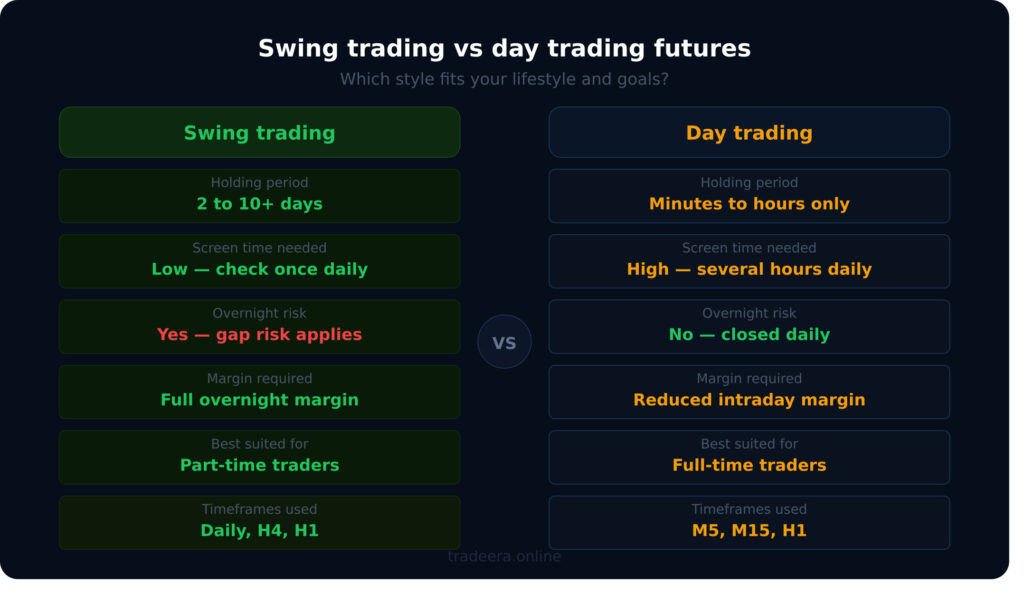
Understanding the difference between these two approaches helps you choose what fits your lifestyle and goals.
| Factor | Swing Trading Futures | Day Trading Futures |
|---|---|---|
| Holding period | 2 to 10+ days | Minutes to hours |
| Screen time required | Low — check once or twice daily | High — several hours daily |
| Overnight risk | Yes — exposed to gaps | No — positions closed daily |
| Margin required | Full overnight margin | Often reduced intraday margin |
| Stress level | Moderate | High |
| Best for | Part-time traders | Full-time traders |
| Timeframes used | Daily, H4, H1 | M5, M15, H1 |
Swing trading is generally more forgiving for beginners. You have more time to think through decisions, less exposure to intraday noise, and the ability to use wider stop-losses that allow your trades room to breathe.
Benefits of Swing Trading Futures
- Flexibility — Analyse markets in the evening, place trades with clear entry and exit levels, and check in briefly during the day
- Larger price moves — Multi-day swings often produce bigger pip-for-pip returns than intraday scalps
- Better risk-reward ratios — Holding for multiple days allows for wider targets relative to stop-loss levels
- Lower transaction costs — Fewer trades means fewer commissions eating into your returns
- Suitable for smaller accounts — Micro contracts require significantly less capital than full-size futures
- Less emotional pressure — Not watching every tick removes the temptation to make impulsive decisions
Risks of Swing Trading Futures
No trading strategy is without risk, and swing trading futures comes with specific challenges every beginner must understand:
- Overnight gap risk — Markets can open significantly higher or lower than where they closed, bypassing your stop-loss
- Higher margin requirements — Holding past the session close requires full exchange-set overnight margin, which is substantially more than intraday margin
- Leverage amplification — The same leverage that boosts gains equally magnifies losses
- Unexpected news events — Geopolitical events, central bank decisions, or earnings reports can move markets sharply against your position overnight
- Patience required — Swing trades take days to play out — emotional traders struggle to hold through short-term volatility
Popular Swing Trading Strategies for Beginners
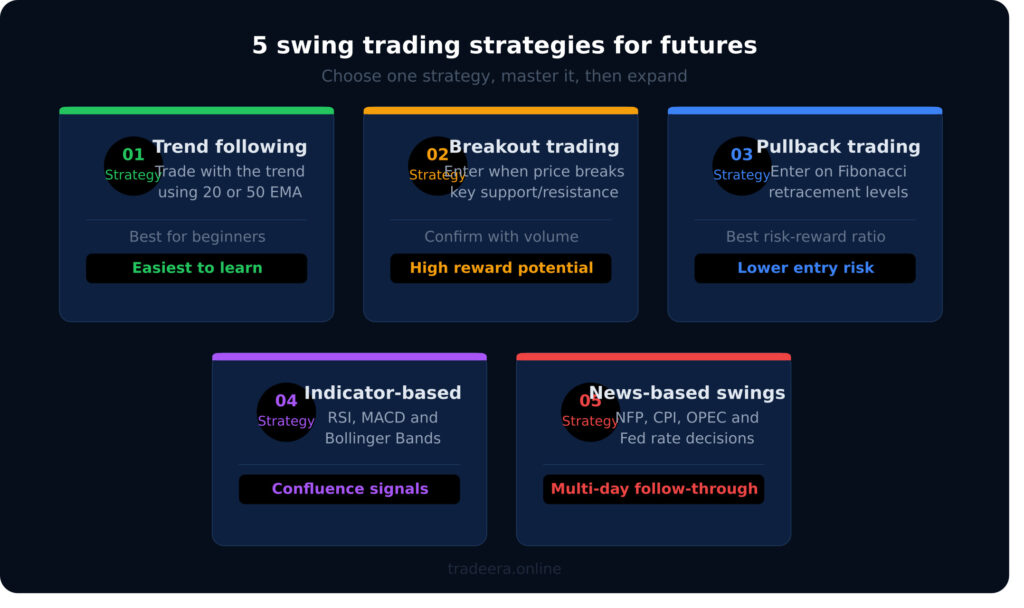
1. Trend Following
The most beginner-friendly swing trading approach. Identify the dominant trend on the daily chart — is price making higher highs and higher lows (uptrend) or lower highs and lower lows (downtrend)? Trade in the direction of that trend using moving averages like the 20 EMA or 50 EMA as dynamic support and resistance.
The rule is simple: only take buy signals in an uptrend, only take sell signals in a downtrend.
2. Breakout Trading
Breakout trading involves identifying a period of consolidation — where price is range-bound between clear support and resistance levels — and entering when price breaks decisively through either boundary.
In futures markets, breakouts often occur before or after major economic events. Volume confirmation is important — a breakout on strong volume is far more reliable than one on thin volume.
3. Pullback Trading
Rather than chasing breakouts, pullback traders wait for price to retrace after a strong move and enter when the pullback shows signs of exhaustion. Fibonacci retracement levels — particularly the 38.2%, 50%, and 61.8% levels — are widely used tools for identifying high-probability pullback entry zones.
This strategy offers excellent risk-reward ratios because you are entering after momentum has temporarily paused, with the trend likely to resume in your favour.
4. Indicator-Based Strategies
Many swing traders use technical indicators to confirm entries and exits:
- RSI (Relative Strength Index) — Look for oversold readings below 30 in an uptrend as a buy signal, or overbought readings above 70 in a downtrend as a sell signal
- MACD — A bullish or bearish crossover of the signal line confirms momentum shifts
- Bollinger Bands — Price touching the lower band in an uptrend can signal a high-probability long entry
Never rely on a single indicator. Confluence — where two or more signals align — produces the most reliable swing trade setups.
5. News-Based Swings
Major economic releases — such as Non-Farm Payrolls, CPI inflation data, OPEC production decisions, and Federal Reserve interest rate announcements — often trigger multi-day directional moves in futures markets.
Experienced swing traders position themselves before anticipated moves or enter after the initial reaction settles, riding the follow-through trend that often develops over several days after a major data release.
Put Swing Trading Strategies into Action
Knowing a strategy intellectually and executing it under real market conditions are two very different things. The most effective way to bridge that gap is through consistent practice.
Start on a demo account and paper trade your chosen strategy for at least three to four weeks. Track every trade — entry reason, stop-loss placement, target, outcome, and what you would do differently. Only move to live trading once your demo results are consistent and your process feels natural.
When you do go live, start with micro contracts. They give you real skin in the game — the psychological pressure of real money — at a fraction of the financial risk of standard contracts.
Best Futures Contracts for Swing Trading
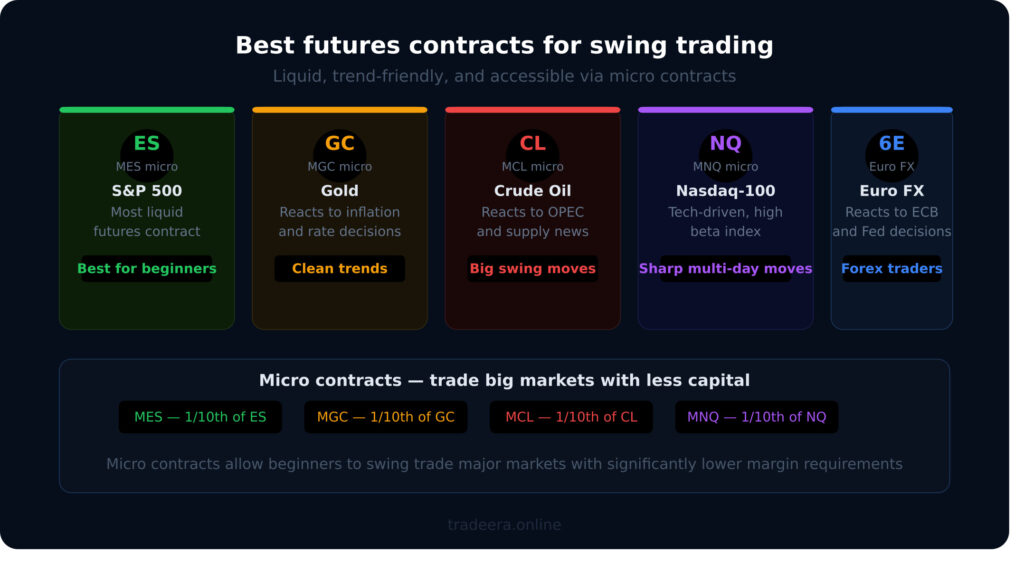
E-mini S&P 500 (ES) and Micro E-mini (MES)
The ES is the most liquid futures contract in the world. It tracks the S&P 500 index and offers consistent multi-day trends that respond well to technical analysis. The MES is one-tenth the size, making it ideal for beginners building confidence. Both contracts are excellent starting points for new swing traders.
Crude Oil (CL) and Micro Crude (MCL)
Crude oil futures are highly responsive to OPEC decisions, US inventory reports, and geopolitical developments. They produce powerful multi-day moves that swing traders can capture with breakout or news-based strategies. The MCL reduces the dollar risk per contract significantly for smaller accounts.
Gold (GC) and Micro Gold (MGC)
Gold responds strongly to inflation data, US dollar strength, and global risk sentiment. During periods of economic uncertainty gold trends cleanly over multiple days, making it one of the most reliable swing trading vehicles available. The MGC offers the same exposure at one-tenth the size.
Nasdaq-100 (NQ) and Micro Nasdaq (MNQ)
The NQ is a technology-heavy index with high beta and sharp multi-day moves. It reacts strongly to earnings reports from major tech companies and Federal Reserve policy decisions. The MNQ is the most beginner-accessible version with lower margin requirements.
Euro FX (6E)
The Euro FX futures contract tracks the EUR/USD exchange rate in a regulated exchange environment. It reacts to European Central Bank decisions, US Federal Reserve policy shifts, and macroeconomic data. For traders with a forex background, the 6E is a familiar and liquid swing trading instrument.
Understanding Overnight Margin in Swing Trading
This is one of the most important concepts beginners miss when first exploring swing trading futures.
Futures brokers offer two types of margin:
| Margin Type | When It Applies | Typical Amount |
|---|---|---|
| Intraday margin | During trading hours only | As low as $50–$500 (broker-set) |
| Overnight margin | Holding past session close | Exchange-set — significantly higher |
For example, while a broker might allow you to day trade one MES contract for as little as $50 intraday, holding that same contract overnight requires the full exchange-set initial margin — typically around $1,500 to $1,800 per contract.
This means swing trading requires more capital than day trading to hold the same number of contracts. Always check your broker’s overnight margin requirements before placing a swing trade and ensure your account has sufficient funds to hold the position for the full duration of the trade.
Tools You Will Need
A successful swing trader needs the right toolkit:
- Trading platform — NinjaTrader, TradeStation, or Sierra Chart are popular choices for futures
- Charting software — TradingView offers excellent futures charting with all major indicators
- Economic calendar — Know when major data releases are scheduled so you are not caught off guard
- Trading journal — Record every trade with entry reasoning, result, and lessons learned
- Demo account — Practice every strategy before going live
- Position size calculator — Calculate lot size based on account balance and risk per trade
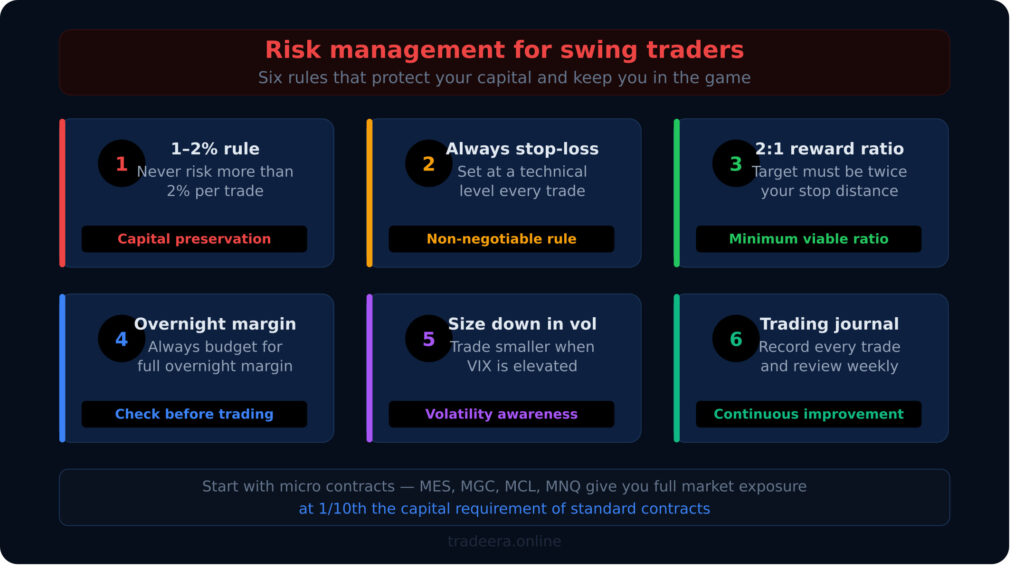
Managing Risk as a Swing Trader
Risk management is what separates traders who survive long enough to become profitable from those who blow their accounts in the first few months.
Core risk management rules for swing trading futures:
- Never risk more than 1 to 2 percent of your total account on any single trade
- Always use a stop-loss — set it at a logical technical level, not an arbitrary dollar amount
- Account for overnight gaps — use slightly wider stops on swing trades to avoid being stopped out by normal overnight volatility
- Maintain a minimum 2:1 risk-reward ratio — your target should be at least twice your stop-loss distance
- Reduce position size in volatile markets — when VIX is elevated or major news is pending, trade smaller
- Never average into a losing position — if the trade is wrong, exit cleanly
Mistakes to Avoid
Even experienced traders fall into these traps — beginners even more so:
- Trading too many contracts too soon — start with one micro contract and scale only after consistent results
- Ignoring overnight margin requirements — running out of margin mid-trade is a costly and avoidable mistake
- Moving stop-losses further away to avoid being stopped out — this destroys your risk management
- Trading without a plan — every trade needs a defined entry, stop, target, and reason before you click the button
- Over-trading during low-conviction setups — not every day has a good swing trade. Patience is a skill
- Ignoring the economic calendar — holding through a major data release without adjusting position size dramatically increases risk
Final Thoughts
Swing trading futures is one of the most accessible and rewarding strategies available to retail traders — but only when approached with proper education, realistic expectations, and disciplined risk management.
Start small. Use micro contracts. Build your skills on a demo account before putting real money at risk. Focus on mastering one market and one strategy before expanding. The traders who succeed in futures over the long term are not the most aggressive — they are the most consistent and the most disciplined.
The futures markets will always be there. Take your time to learn them properly and your edge will compound over time.
FAQs About Swing Trading Futures
What is swing trading in futures?
Swing trading futures means holding futures contracts for several days to capture medium-term price moves, rather than closing positions within the same trading day.
Is swing trading futures good for beginners?
Yes — especially using micro futures contracts. Swing trading requires less screen time than day trading and allows for more thoughtful, planned decision-making.
How long do you hold a swing trade in futures?
Most swing trades in futures are held between two and ten trading days, though some setups may be held for two to three weeks depending on the strategy.
What are the best futures contracts for swing trading?
The E-mini S&P 500 (ES), Micro E-mini (MES), Gold (GC), Crude Oil (CL), and Nasdaq-100 (NQ) are the most popular futures contracts for swing trading due to their liquidity and clear trend behaviour.
What is the difference between swing trading and day trading futures?
Day traders open and close positions within the same session. Swing traders hold positions overnight and for multiple days, targeting larger price moves.
How much capital do you need to swing trade futures?
It depends on the contract and overnight margin requirement. Micro futures require significantly less capital — typically $1,500 to $2,500 per contract for overnight positions.
Is there overnight margin in swing trading futures?
Yes — holding a futures position past the daily session close requires meeting the exchange-set overnight (initial) margin, which is substantially higher than intraday margin rates.
Can you swing trade futures part-time?
Absolutely. Swing trading is specifically well-suited to part-time traders because positions are managed on daily and four-hour charts that only require brief analysis once or twice per day.
⚠️ Risk Warning: Trading futures involves substantial risk of loss and is not suitable for all investors. Leverage can work against you as well as for you. Always use proper risk management and never trade with capital you cannot afford to lose.
Trade Era — Your Trusted Source for Trading Education