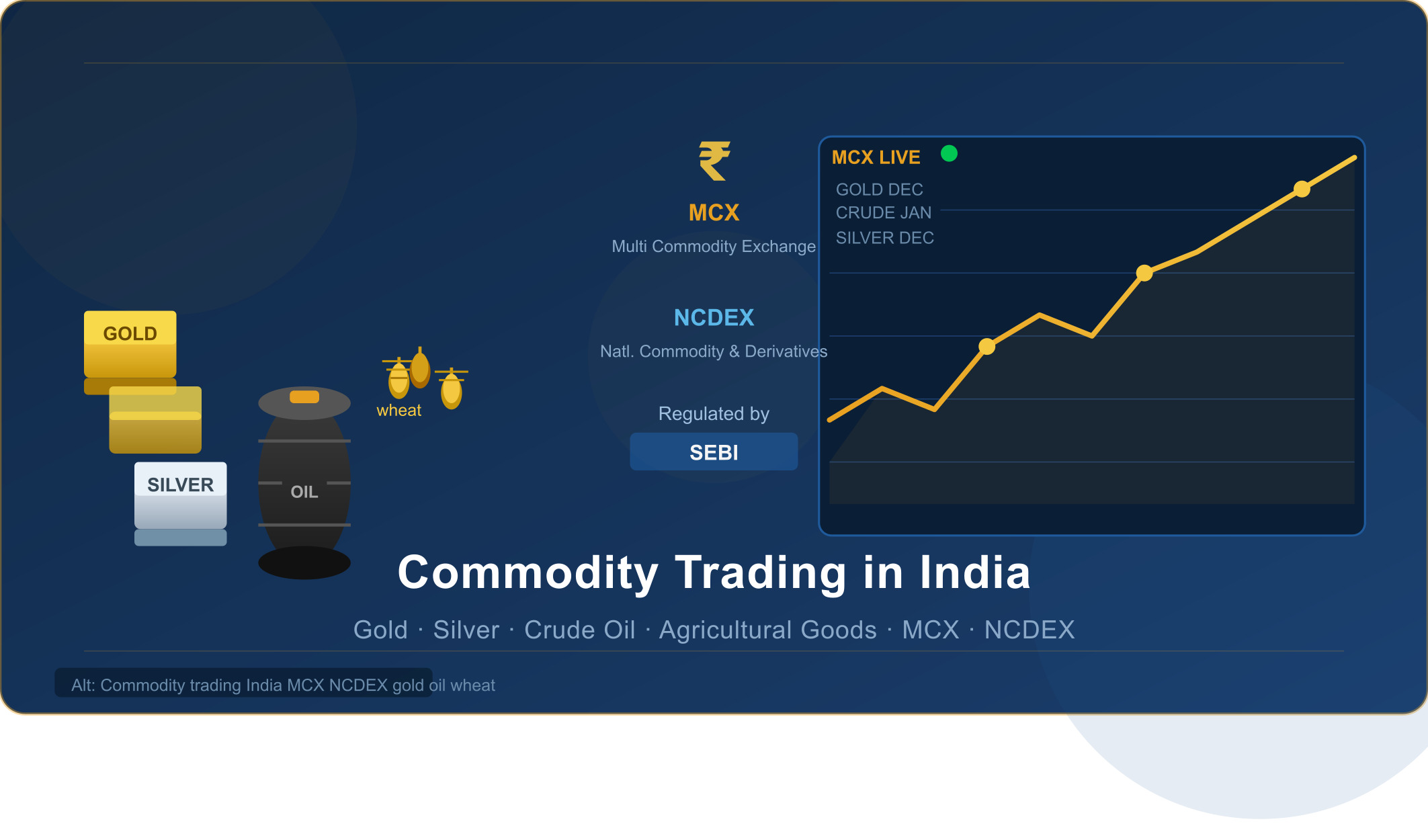
Every day, millions of traders in India buy and sell gold, crude oil, wheat, and dozens of other raw materials without ever touching a physical product. That is the power of commodity trading. Whether you want to diversify your portfolio, protect against inflation, or simply explore a new asset class, commodity markets offer real opportunities — along with real risks. This guide breaks down everything from the basics to step-by-step trading instructions, beginner strategies, and the key India-specific exchanges you need to know.
What Is Commodity Trading?
Commodity trading is the buying and selling of raw materials or primary goods — such as gold, silver, crude oil, natural gas, wheat, cotton, and spices — through regulated financial exchanges. Unlike stock trading, where you purchase ownership in a company, commodity trading focuses on tangible, physical goods that the global economy depends on.
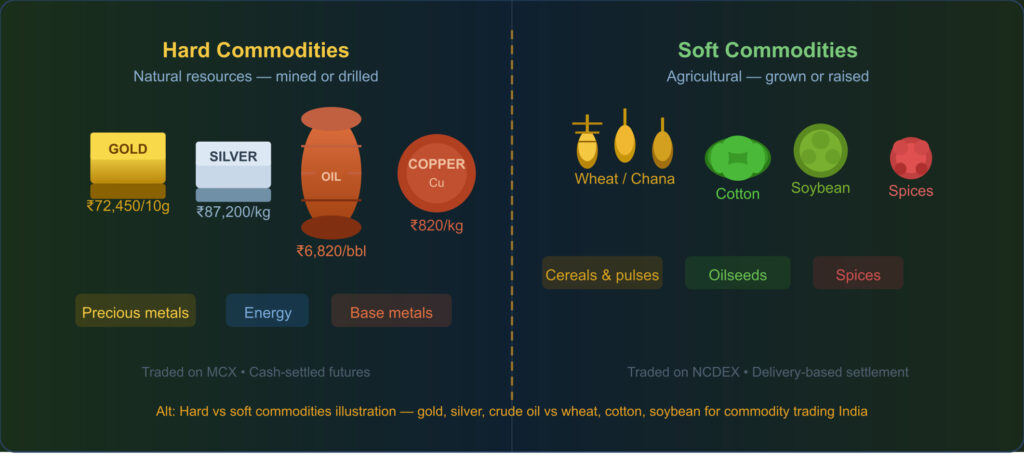
Commodities are broadly classified into two categories:
- Hard Commodities: Natural resources extracted through mining or drilling — gold, silver, copper, crude oil, natural gas.
- Soft Commodities: Agricultural products grown or raised — wheat, rice, cotton, soybeans, spices, pulses.
In India, commodity trading is conducted on regulated exchanges like MCX and NCDEX, both supervised by the Securities and Exchange Board of India (SEBI). Most retail traders participate through futures and options contracts rather than buying physical goods.
🌐 Why Commodities Are Traded Globally
Price discovery · Risk management · Portfolio diversification
Alt: “Diagram showing why commodities are traded — hedging, speculation, and price discovery on global markets” | Caption: “Commodity markets serve critical roles for farmers, manufacturers, investors, and the broader economy.”
Why Are Commodities Traded?
Commodity markets exist for three core reasons:
- Price Discovery: Exchanges like MCX and NCDEX help establish fair, transparent prices based on live supply and demand forces — reducing uncertainty for producers and consumers alike.
- Risk Management (Hedging): A wheat farmer worried about a price drop can lock in today’s price by selling a futures contract. A flour mill worried about rising input costs can buy futures to secure supply at a fixed rate.
- Investment and Speculation: Traders profit by forecasting price movements. When managed with discipline, commodity trading can generate returns independent of the stock market — making it a valuable diversification tool.
How Does Commodity Trading Work?
Commodity trading in India primarily operates through derivative contracts — agreements whose value is based on an underlying commodity. Here is how the mechanism works:
1. Futures Contracts
A futures contract is a standardized agreement to buy or sell a specific quantity of a commodity at a predetermined price on a future date. For example, if you buy a gold futures contract on MCX at ₹72,000 per 10 grams and gold rises to ₹76,000 before expiry, you pocket the difference without ever touching physical gold.
💡 Key Point: Most traders in India never take physical delivery. They “square off” — close their position before the contract expires — and settle the profit or loss in cash.
2. Speculation and Hedging
Speculators take positions to profit from price swings. They provide liquidity to the market and help narrow bid-ask spreads. Hedgers — such as farmers, manufacturers, and importers — use futures to protect against adverse price moves. Both are essential to a healthy commodity market.
MCX – Multi Commodity Exchange
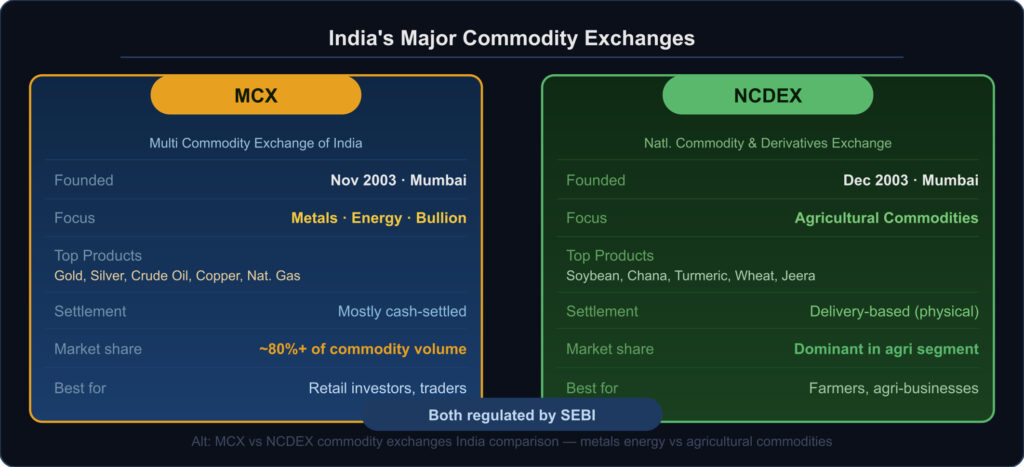
Established in November 2003 and headquartered in Mumbai, the Multi Commodity Exchange (MCX) is India’s largest commodity exchange by trading volume — accounting for over 80% of the country’s total commodity market turnover.
MCX offers futures and options contracts in:
- Precious Metals: Gold, Silver
- Base Metals: Copper, Aluminium, Zinc, Lead, Nickel
- Energy: Crude Oil, Natural Gas
- Agricultural: Mentha Oil, Cardamom, Cotton, Palm Oil
MCX operates under SEBI’s regulatory framework and provides full transparency in pricing, volumes, and trade data through its iCOMDEX commodity index series.
NCDEX – National Commodity & Derivatives Exchange
Founded in December 2003 with backing from institutions like NABARD, LIC, IFFCO, and Canara Bank, NCDEX is India’s primary platform for agricultural commodity trading. While MCX leads in metals and energy, NCDEX is the go-to exchange for farmers, traders, and agri-businesses.
NCDEX offers contracts for over 57 commodities, including cereals, pulses, oilseeds, spices, and fibers. A unique feature of NCDEX is its delivery-based settlement system, ensuring actual physical delivery of commodities upon contract expiry — critical for agricultural supply chains.
| Feature | MCX | NCDEX |
|---|---|---|
| Founded | November 2003 | December 2003 |
| Primary Focus | Metals, Energy, Bullion | Agricultural Commodities |
| Top Products | Gold, Crude Oil, Silver, Copper | Soybean, Chana, Turmeric, Wheat |
| Settlement | Mostly cash-settled | Delivery-based (physical) |
| Market Share | ~80%+ of commodity volume | Dominant in agri segment |
| Primary Users | Retail investors, traders | Farmers, agri businesses |
| Regulator | SEBI | SEBI |
🪙 How to Start Commodity Trading
Open account → Choose commodity → Place order → Monitor → Exit
Alt: “Step-by-step flowchart showing how to start commodity trading in India with MCX broker account” | Caption: “Starting commodity trading in India is straightforward once you know the five essential steps.”
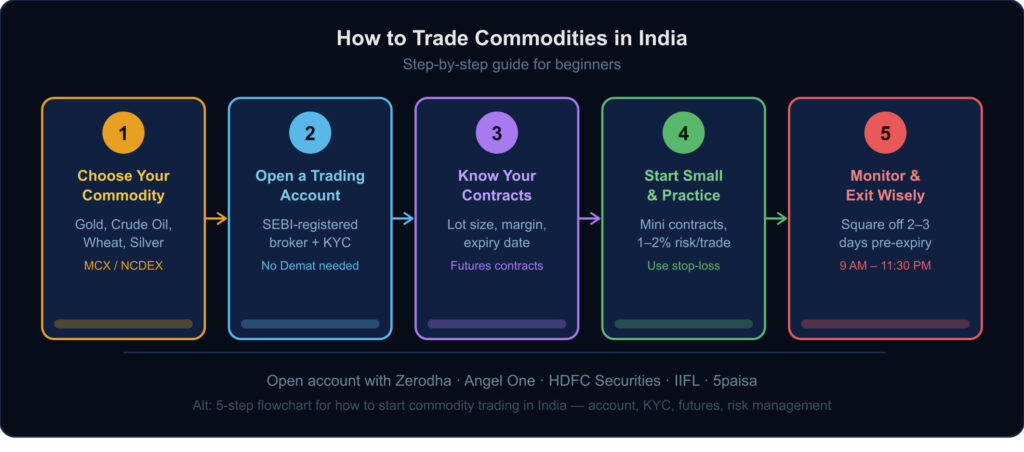
How to Trade Commodities?
Here is a clear, step-by-step path for anyone starting out in commodity markets in India:
- Step 1: Choose Your CommodityStart with commodities you understand. Gold and crude oil are popular for beginners due to their high liquidity and globally tracked price drivers. Agricultural commodities like chana or soybean require understanding of seasonal and policy factors.
- Step 2: Open a Trading AccountSelect a SEBI-registered broker who is a member of MCX or NCDEX (e.g., Zerodha, Angel One, HDFC Securities, IIFL). Complete the KYC process with your PAN card, Aadhaar, bank details, and a cancelled cheque. No separate Demat account is required for futures trading.
- Step 3: Know Your ContractsEach commodity has a standardized lot size and margin requirement. For example, a standard Gold futures contract is 1 kg; the Gold Mini is 100 grams. Understand the lot size, contract expiry date, and margin before placing a trade.
- Step 4: Start SmallUse mini or micro contracts when learning. Do not risk more than 1–2% of your capital on a single trade. Use stop-loss orders to limit potential losses on every position.
- Step 5: Monitor and Exit WiselyCommodity markets trade from 9 AM to 11:30 PM IST on weekdays (MCX). Always square off your position at least 2–3 days before contract expiry to avoid physical delivery obligations.
Beginner Commodity Trading Strategies
1. Trend Following
Identify the direction in which a commodity’s price is moving using moving averages or trend lines, then trade in that direction. Pair this with momentum indicators like the RSI (Relative Strength Index) to confirm entry points. Use trailing stop-losses to protect profits as the trend extends.
2. Range Trading
When a commodity price moves between two well-defined levels — support and resistance — buy near support and sell near resistance. This approach works best during low-volatility periods. Always exit the trade if the price breaks through either boundary.
3. Fundamental Analysis
Study the supply-demand fundamentals for your chosen commodity. For crude oil, monitor OPEC decisions and US inventory data. For agricultural goods, track weather reports, crop estimates, and government procurement policies. Fundamentals drive medium-to-long-term price trends.
4. Technical Analysis
Use chart patterns (head and shoulders, flags, triangles) and indicators (MACD, Bollinger Bands, Volume) to time your entry and exit. Technical analysis is especially effective in liquid commodities like gold and crude oil, where price action is consistent and well-documented.
5. Risk Management
This is not optional — it is the foundation of sustainable trading. Set a stop-loss for every trade, never over-leverage your account, diversify across at least 2–3 commodities, and review your trades weekly to identify recurring mistakes.
💼 Investing vs. Trading Commodities
ETFs · Mutual Funds · Sovereign Gold Bonds · Physical Gold
Alt: “Comparison graphic showing different ways to invest in commodities in India — ETFs, mutual funds, and sovereign gold bonds” | Caption: “You don’t need to trade futures to gain commodity exposure — ETFs and mutual funds offer simpler entry points for long-term investors.”
How to Invest in Commodities? (Not Just Trade)
If active futures trading feels too complex, there are easier ways to get commodity exposure as an investor:
- Commodity ETFs: Funds like Gold ETFs or Silver ETFs trade on NSE/BSE and track commodity prices without requiring a commodity trading account.
- Commodity Mutual Funds: Funds that invest in a basket of commodities or commodity-producing companies. Suitable for long-term, passive investors.
- Sovereign Gold Bonds (SGBs): Government-issued bonds linked to gold prices, offering 2.5% annual interest plus capital appreciation — and zero storage risk.
- Physical Ownership: Buying physical gold, silver, or other goods directly. Not ideal for trading but suitable as a store of value.
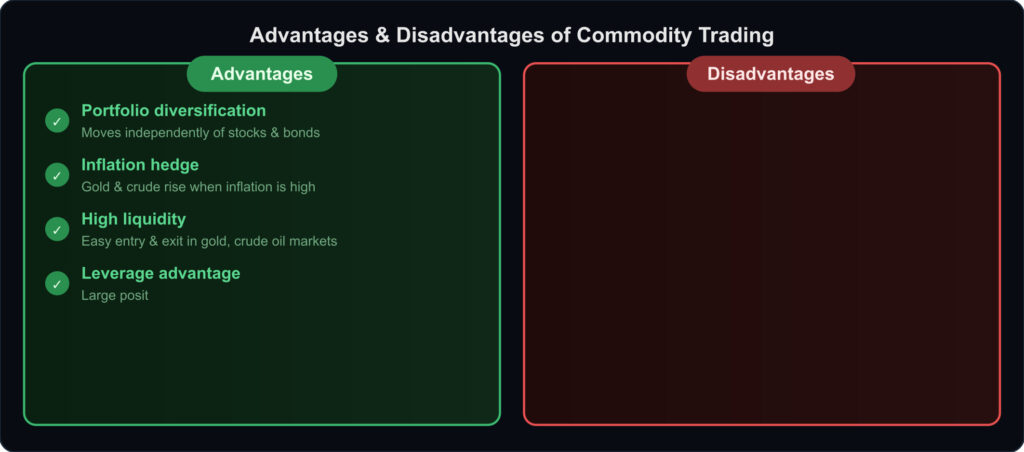
Advantages and Disadvantages of Trading Commodities
✅ Advantages
- Portfolio Diversification: Commodities move independently of stocks and bonds.
- Inflation Hedge: Gold and oil tend to rise when inflation is high.
- High Liquidity: Major commodities like gold and crude oil see billions in daily trading volume.
- Leverage Available: Trade large positions with a smaller margin deposit.
- Extended Trading Hours: MCX runs until 11:30 PM, allowing after-office participation.
- Less Manipulation: Commodity prices are globally determined, reducing local price manipulation risk.
❌ Disadvantages
- High Volatility: Geopolitical events and weather can cause sudden, sharp price moves.
- Leverage Risk: The same leverage that magnifies profits also amplifies losses.
- Complex Factors: Global politics, currency rates, monsoon cycles, and government policy all affect prices.
- Contract Expiry Pressure: Every futures contract has an expiry; poor timing can be costly.
- Not Tax-Free: Commodity trading profits are taxable as business income in India.
Conclusion
Commodity trading offers a powerful way to diversify your investments, hedge against inflation, and participate in global markets — all from the comfort of your trading terminal. In India, MCX and NCDEX provide SEBI-regulated, transparent platforms for trading everything from gold and crude oil to soybean and turmeric.
The key to success in commodity trading is education before execution. Understand the commodity you are trading, master your risk management, start with small positions, and build your experience gradually. Whether you are a farmer looking to hedge your crop price or an investor seeking a new asset class, the commodity market has a place for you.
Always consult a SEBI-registered investment advisor before making significant financial decisions.
FAQs
1. What is a start fund for commodity trading in India?
There is no official minimum, but most brokers require a margin deposit of ₹5,000–₹20,000 to begin trading commodity futures in India, depending on the commodity and contract size chosen.
2. Is it possible for new traders to trade commodities?
Yes, beginners can trade commodities on MCX or NCDEX by opening a trading account with a SEBI-registered broker. Starting with mini contracts and a solid risk management plan is strongly recommended.
3. Do we require a physical Demat account to trade commodities?
No. A Demat account is not required for trading commodity futures and options. However, if you plan to invest in commodity ETFs or mutual funds, a Demat account becomes necessary.
4. Is stock trading or commodity trading better?
Neither is universally better — they serve different purposes. Stocks are suited for long-term wealth creation, while commodities excel at portfolio diversification and inflation hedging. Many investors use both strategically.
5. Is profit on commodity trading tax-free in India?
No. Commodity trading profits in India are taxable. Intraday commodity trades are treated as speculative business income, while overnight positions are non-speculative business income — both added to your total taxable income per your applicable slab rate.