Key Takeaways Stocks
- Stock trading involves buying and selling shares to profit from short-term price movements
- Choosing the right trading style and brokerage is the foundation of your journey
- Both fundamental and technical analysis are essential tools for making informed decisions
- Risk management — including stop-loss orders and position sizing — protects your capital
- Beginners should always practice on a demo account before trading with real money
Learning how to trade stocks can feel overwhelming at first — but it does not have to be. Whether you want to day trade for quick profits or swing trade over several days, the process follows a clear and learnable path. Millions of people trade stocks every single day, and with the right knowledge, discipline, and strategy, you can join them confidently.
This step-by-step guide walks you through everything you need to know — from choosing your trading style to placing your first order and managing risk like a professional.
1. Decide What Type of Trader You Want to Be
Before you open a brokerage account or research a single stock, you need to understand yourself. Your trading style should match your personality, available time, risk tolerance, and financial goals.
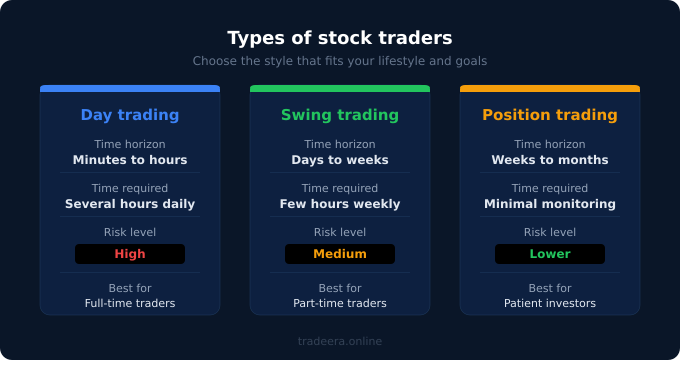
Here is a quick breakdown of the most common trading styles:
| Trading Style | Time Horizon | Time Required | Risk Level |
|---|---|---|---|
| Day Trading | Minutes to hours | High — several hours daily | High |
| Swing Trading | Days to weeks | Moderate — a few hours weekly | Medium |
| Position Trading | Weeks to months | Low — occasional monitoring | Medium-Low |
| Long-Term Investing | Months to years | Minimal | Lower |
Ask yourself honestly — can you sit in front of a screen for hours watching price movements? Or do you prefer making fewer, more calculated decisions over several days? There is no wrong answer. The key is choosing a style you can actually stick to.
Fast Fact
Studies consistently show that traders who clearly define their strategy before entering the market perform significantly better than those who trade impulsively. Knowing your style is not optional — it is the foundation everything else is built on.
2. Research Brokerages and Choose One Suitable for You
Your brokerage is your gateway to the stock market. Not all brokers are created equal — some are built for fast day traders while others cater to long-term investors. Choosing the wrong one can cost you money in fees, poor execution, or missing tools.
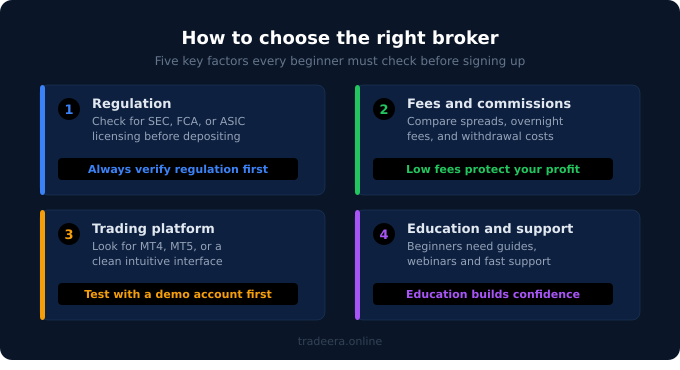
Key factors to evaluate when choosing a broker:
- Regulation — Always choose a broker regulated by a recognized authority such as the SEC, FCA, or ASIC
- Trading platform — Look for a clean, reliable platform like thinkorswim, Interactive Brokers, or Webull
- Fees and commissions — Many brokers now offer commission-free trades, but check for hidden fees
- Educational resources — Especially important for beginners
- Customer support — Responsive support matters when things go wrong
Brokerages for Day Traders
Day traders need lightning-fast execution, advanced charting tools, Level 2 quotes, and low fees per trade. Platforms like Interactive Brokers, TD Ameritrade’s thinkorswim, and Webull are popular choices among active day traders because of their speed and analytical depth.
Brokerages for Swing Traders
Swing traders need solid charting tools, screeners, and the ability to hold positions overnight. Platforms like Fidelity, Charles Schwab, and TradeStation offer a good balance of tools, research, and reasonable fees.
Brokerages for Long-Term Investors
Long-term investors prioritize low fees, dividend reinvestment options, and ease of use. Platforms like Vanguard, Fidelity, and Robinhood are well suited for investors who do not need advanced trading tools.
Tip
Always open a demo account first. Most reputable brokers offer paper trading accounts where you can practice with virtual money before risking real capital. This is one of the smartest moves any new trader can make.
3. Open and Fund a Brokerage Account
Once you have chosen your broker, opening an account is straightforward. Most online brokers let you complete the process in under 15 minutes from your phone or computer.
Here is what you will typically need:
- Government-issued photo ID
- Social Security Number or Tax ID
- Bank account details for funding
- Basic personal and financial information
After your account is verified, fund it with an amount you are genuinely comfortable losing. Many brokers have no minimum deposit requirement, though starting with at least $500 to $1,000 gives you more flexibility with position sizing and risk management.
Tip
Never fund your trading account with money you cannot afford to lose. Stock trading carries real financial risk. Start small, learn the process, and scale up only when you have consistent results to justify it.
4. Research the Stocks You Want to Own
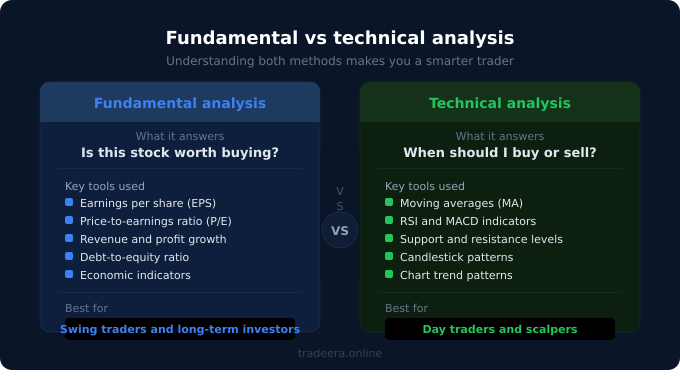
This is where serious trading begins. Before placing any trade, you need to understand what you are buying and why. There are three primary approaches to stock research.
Fundamental Analysis
Fundamental analysis evaluates the underlying financial health of a company. You are asking — is this business actually worth owning?
Key metrics to examine include:
- Earnings per share (EPS) — How much profit the company generates per share
- Price-to-earnings ratio (P/E) — Whether the stock is overvalued or undervalued relative to earnings
- Revenue growth — Is the company growing consistently?
- Debt-to-equity ratio — How much the company owes versus what it owns
- Dividend yield — Relevant for income-focused investors
Fundamental analysis is most useful for swing traders and long-term investors looking for quality companies trading below their intrinsic value.
Technical Analysis
Technical analysis studies price charts, patterns, and indicators to forecast future price movements. Instead of asking what a company is worth, technical traders ask — where is the price likely to go next?
Common technical tools include:
- Moving averages (MA) — Identify trends and dynamic support and resistance levels
- Relative Strength Index (RSI) — Measures momentum and highlights overbought or oversold conditions
- MACD — Tracks the relationship between two moving averages to signal trend changes
- Support and resistance levels — Price zones where buying or selling pressure has historically appeared
- Candlestick patterns — Visual price patterns that signal potential reversals or continuations
Other Methods
Some traders also use sentiment analysis — gauging market mood through news headlines, social media trends, and investor surveys. Others use quantitative screening tools to filter thousands of stocks down to a shortlist based on specific criteria.
Tip
Do not rely on a single method. The most effective traders combine fundamental analysis to identify what to buy with technical analysis to determine the best time to enter and exit.
5. Place Your Order to Buy or Sell Stocks
Once your research is complete and you are ready to trade, you need to understand the different order types available on your platform.
| Order Type | Description | Best Used When |
|---|---|---|
| Market Order | Executes immediately at current market price | You need fast execution |
| Limit Order | Executes only at your specified price or better | You want price control |
| Stop Order | Triggers a market order when price hits your stop level | Protecting against losses |
| Stop-Limit Order | Triggers a limit order at your stop level | Combining price control with protection |
Always double-check your order details before submitting — the number of shares, order type, and price. A small error can result in a trade you did not intend.
Important
Specify the time in force for your order. A Day Order expires at the end of the trading session if unfilled. A Good Till Cancelled (GTC) order remains active until you cancel it or it is executed. Choosing the wrong setting can lead to unexpected trades being placed days later.
6. Manage Risk
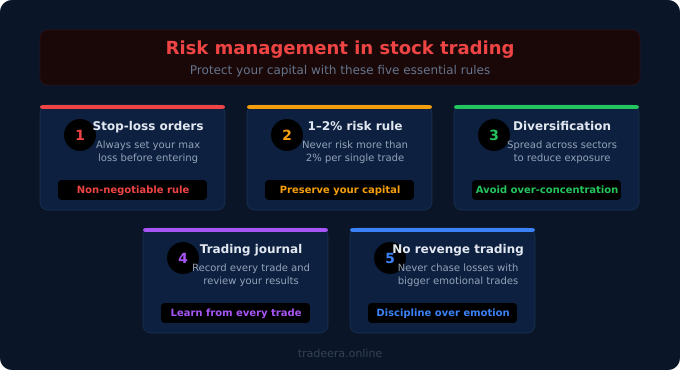
Risk management is the single most important skill any trader can develop. Without it, even the best stock picks can lead to devastating losses.
Core risk management principles every trader must follow:
- Use stop-loss orders — Always define your maximum acceptable loss before entering a trade
- Risk only 1–2% per trade — Never put more than a small percentage of your account on a single position
- Diversify your positions — Avoid putting all your capital into one stock or sector
- Keep a trading journal — Record every trade, the reasoning behind it, and the outcome
- Never chase losses — Emotional trading after a loss leads to bigger losses
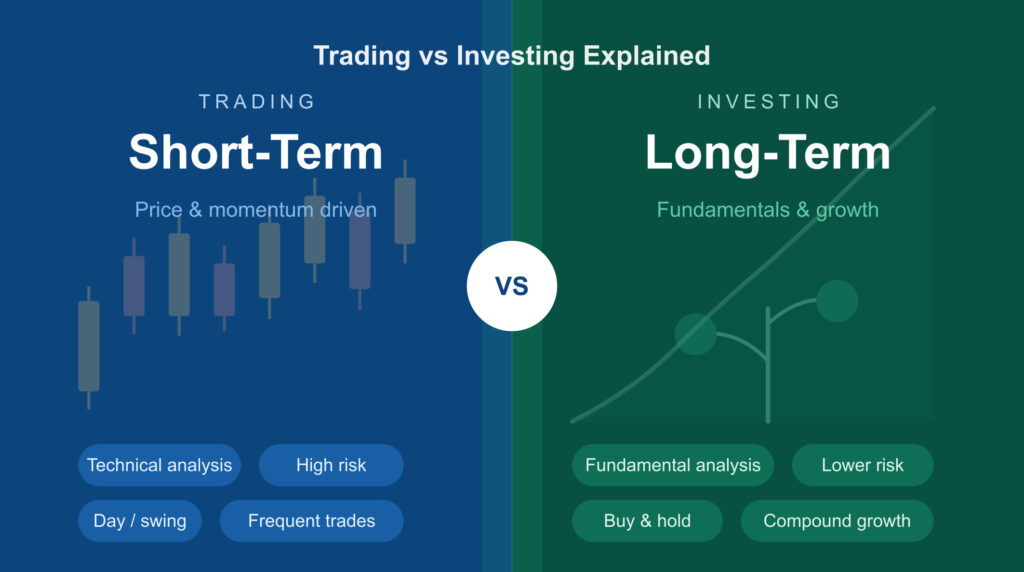
Are There Main Differences Between Trading and Investing?
Yes — the core differences lie in time horizon, intent, and tools used.
| Factor | Trading | Investing |
|---|---|---|
| Time Horizon | Short term — minutes to weeks | Long term — years to decades |
| Primary Goal | Profit from price movements | Build wealth through ownership |
| Tools Used | Technical analysis, charts | Fundamental analysis, financials |
| Risk Level | Generally higher | Generally lower |
| Asset Ownership | Not always (e.g. CFDs) | Usually yes |
What Are Some Common Trading Strategies?
The most widely used stock trading strategies include trend following (trading in the direction of the prevailing market trend), breakout trading (entering when price breaks through a key level), mean reversion (betting that prices will return to their average), and momentum trading (buying stocks showing strong upward price movement).
Is Technical Analysis or Fundamental Analysis More Important in Trading?
Neither is universally superior — it depends on your trading style. Day traders and scalpers rely almost entirely on technical analysis because they need fast, chart-based decisions. Long-term investors lean heavily on fundamentals. Most professional traders use both together for the strongest results.
What Are the Traits of a Successful Trader?
Successful traders share several key characteristics: strong discipline to follow their strategy without emotional interference, solid risk management habits, continuous education and market awareness, patience to wait for high-quality setups, and the mental resilience to recover from losing trades without abandoning their plan.
The Bottom Line
Learning how to trade stocks is a journey that rewards patience, preparation, and consistent effort. Start by defining your trading style, choose a regulated broker that fits your needs, and always research your trades before acting. Use both fundamental and technical analysis to build conviction, manage your risk on every single trade, and never stop learning.
The market rewards those who are prepared. Open a demo account, practice your strategy, and only move to live trading when you have built real confidence and consistency.
⚠️ Risk Warning: Stock trading involves significant risk of loss and is not suitable for all investors. Past performance is not indicative of future results. Always trade with money you can afford to lose and consider seeking independent financial advice before trading.