Cryptocurrency has gone from a niche technology experiment to a global financial phenomenon worth trillions of dollars. Yet for most people, the question remains the same — how does it actually work? If you have been curious about Bitcoin, Ethereum, blockchain, and digital wallets but do not know where to begin, this guide breaks everything down in plain, simple language.
Key Takeaways
- Cryptocurrency is a digital form of money secured by cryptography and powered by blockchain technology
- It operates without a central authority like a bank or government
- Thousands of cryptocurrencies exist — each with different purposes and use cases
- You can buy, store, and trade crypto through regulated exchanges and digital wallets
- Like any investment, cryptocurrency carries significant financial risk
Decentralized Finance (DeFi): The Future of Finance
Decentralized Finance — commonly known as DeFi — is one of the most exciting developments in the crypto world. It refers to a growing ecosystem of financial services including lending, borrowing, trading, and earning interest that operate entirely on blockchain networks without banks or intermediaries. Platforms like Uniswap and Aave allow users to access financial tools directly from their digital wallets, 24 hours a day, anywhere in the world.
What is Cryptocurrency?
Cryptocurrency is a form of digital currency that exists only online. Unlike the money in your bank account, it is not issued or controlled by any government or central bank. Instead it runs on a decentralized network of computers that collectively verify and record every transaction.
The word cryptocurrency comes from the use of cryptography — advanced mathematical techniques that secure transactions and control the creation of new coins. Bitcoin, launched in 2009 by the anonymous creator known as Satoshi Nakamoto, was the world’s first cryptocurrency. Today there are thousands of digital currencies, each serving different purposes.
How Does Cryptocurrency Work?
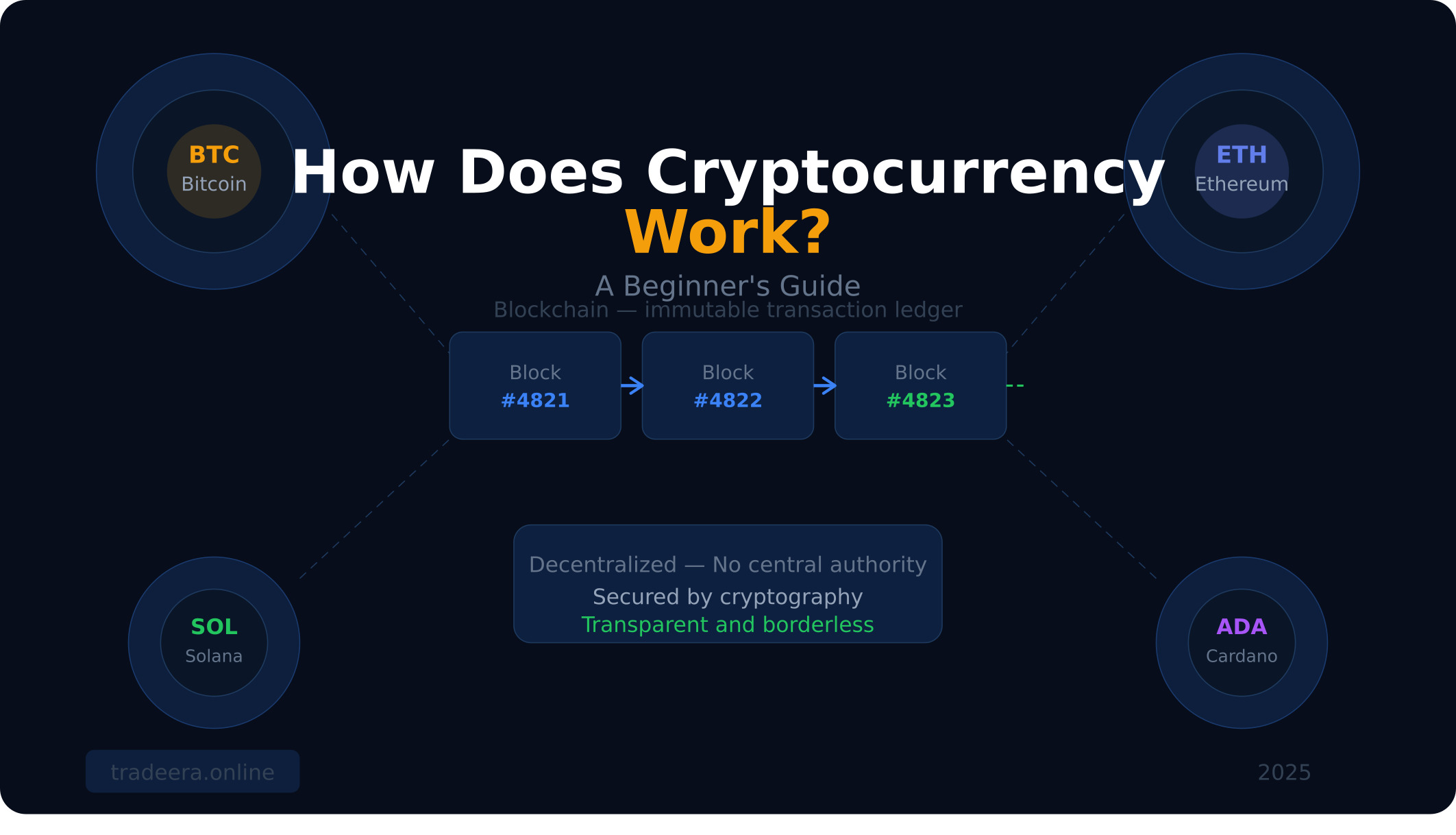
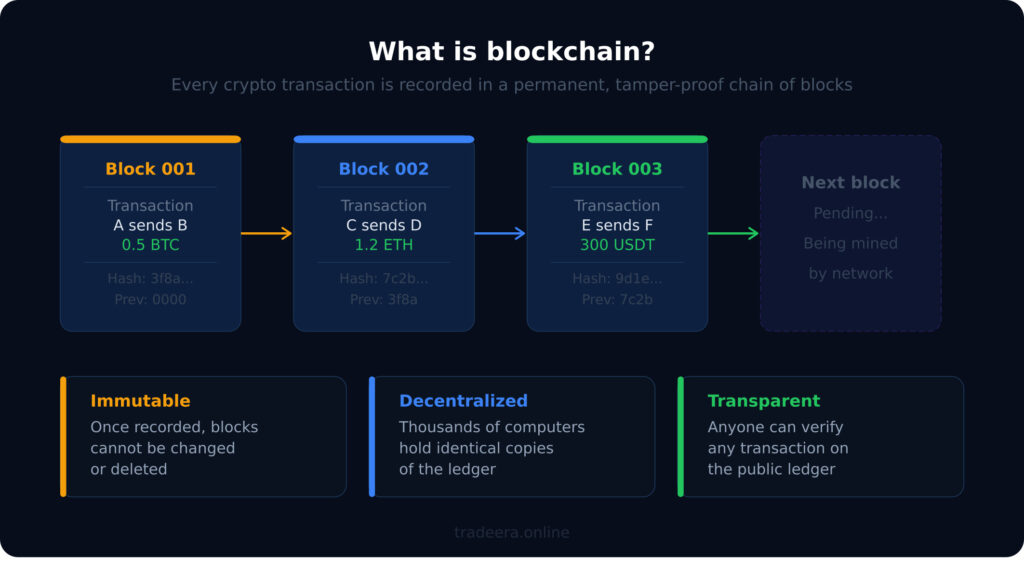
At its core, cryptocurrency works through a technology called blockchain — a shared digital ledger that records every transaction across thousands of computers simultaneously. When you send cryptocurrency to someone, that transaction is broadcast to the network, verified by multiple computers, grouped with other transactions into a block, and permanently added to the chain.
This process makes transactions transparent, tamper-resistant, and impossible to reverse without network consensus.
Cryptocurrency vs. Traditional Currency
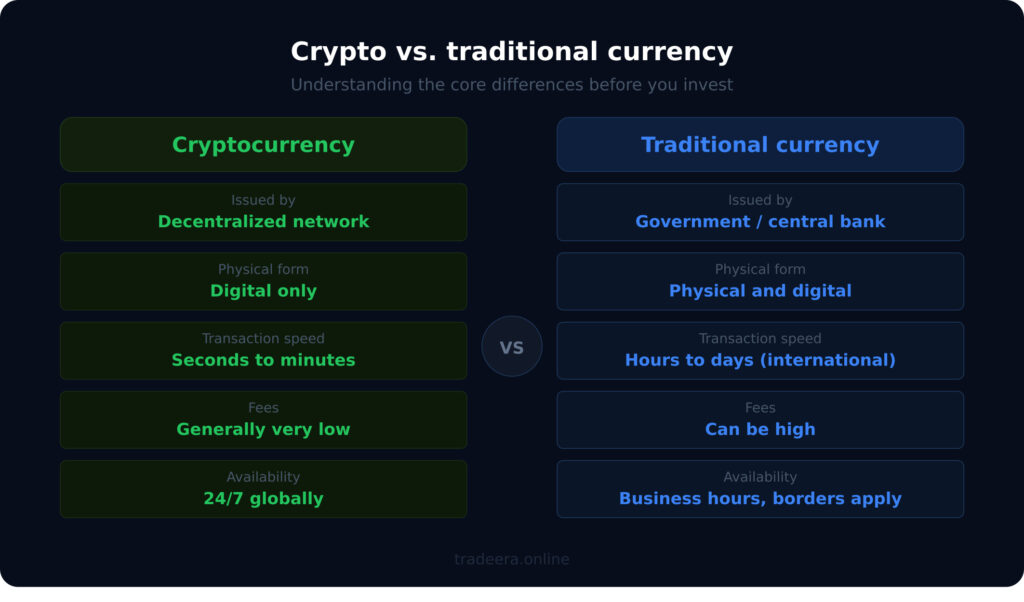
| Feature | Cryptocurrency | Traditional Currency |
|---|---|---|
| Issued by | Decentralized network | Government or central bank |
| Physical form | Digital only | Physical and digital |
| Control | Community governed | Government regulated |
| Transaction speed | Minutes to seconds | Hours to days (international) |
| Fees | Generally low | Can be high |
| Availability | 24/7 globally | Business hours, borders apply |
How Does Cryptocurrency Price Work?
Crypto prices are driven entirely by supply and demand. When more people want to buy a coin than sell it, the price rises. When sellers outnumber buyers, the price falls. Unlike stocks, there are no earnings reports or dividends. Factors that influence crypto prices include news events, regulatory decisions, technological developments, market sentiment, and the activity of large investors known as whales.
What is Mining Cryptocurrency and How Does it Work?
Mining is the process by which new cryptocurrency transactions are verified and added to the blockchain. Miners use powerful computers to solve complex mathematical puzzles. The first miner to solve the puzzle gets to add the next block of transactions and receives a reward in newly created coins. This process is called Proof of Work and is used by Bitcoin. Ethereum switched to a more energy-efficient method called Proof of Stake in 2022, where validators are chosen based on the amount of crypto they lock up as collateral.
Is Cryptocurrency a Good Investment?
Cryptocurrency can offer significant returns but comes with equally significant risk. Prices are highly volatile — assets can gain or lose 50% or more within weeks. It can be a worthwhile component of a diversified portfolio for investors who understand the risks and invest only what they can afford to lose. It is not suitable for everyone.
Blockchain and Cryptocurrency Explained
Think of blockchain as a notebook shared between thousands of people at once. Every time a transaction happens, it gets written into this notebook. No single person controls it, no entry can be erased, and every participant can verify its accuracy. This shared, transparent, and permanent record is what makes cryptocurrency fundamentally different from traditional digital payments.
What Are the Advantages of Cryptocurrency?
Cryptocurrency offers several compelling benefits:
- Decentralization — No single authority controls it, reducing the risk of government manipulation or bank failures
- Borderless transactions — Send money anywhere in the world within minutes at low cost
- Transparency — All transactions are publicly recorded on the blockchain
- Financial inclusion — People without access to traditional banking can participate in the global economy
- Security — Cryptographic technology makes transactions extremely difficult to forge or hack
- Ownership — You hold your assets directly without relying on a third party
Types of Cryptocurrency
There are several broad categories of cryptocurrency:
- Bitcoin (BTC) — The original cryptocurrency, used primarily as a store of value and digital gold
- Altcoins — All cryptocurrencies other than Bitcoin, including Ethereum, Solana, and Cardano
- Stablecoins — Coins pegged to a stable asset like the US dollar, such as USDT and USDC
- Utility tokens — Coins that provide access to specific platforms or services
- Governance tokens — Allow holders to vote on the future direction of a blockchain protocol
- Meme coins — Community-driven coins like Dogecoin, often highly speculative
Can Crypto Exchange Be Centralized?
Yes. Most beginners use centralized exchanges such as Coinbase, Binance, or Kraken. These platforms work like traditional brokerages — they hold your funds, manage your account, and execute trades on your behalf. Decentralized exchanges (DEXs) on the other hand allow peer-to-peer trading directly from your wallet with no middleman involved.
Types of Cryptocurrency Investments
| Investment Type | Description | Risk Level |
|---|---|---|
| Spot buying | Directly purchasing and holding crypto | Medium |
| Crypto ETFs | Funds tracking crypto prices | Medium |
| Futures trading | Contracts betting on future price | High |
| Staking | Locking crypto to earn rewards | Medium |
| DeFi lending | Lending crypto for interest | High |
| NFTs | Unique digital assets on blockchain | Very High |
What to Do Before You Make an Investment in Cryptocurrency
Is Cryptocurrency Safe?
Cryptocurrency itself is secured by strong cryptography, making the technology highly robust. However the risks come from human factors — scams, exchange hacks, lost passwords, and emotional decision making. Always use regulated exchanges, enable two-factor authentication, and never share your private keys or seed phrase with anyone.
1. Define Your Investment Goals
Before investing ask yourself — am I looking for short-term gains or long-term wealth building? How much of my portfolio am I comfortable allocating to a high-risk asset? Having clear goals prevents emotional decisions during market volatility.
2. Analyze the State of the Crypto Industry
Research the overall market cycle, regulatory environment, and sentiment before entering. Understand which projects have real use cases and which are purely speculative. News about government regulation, institutional adoption, and technological developments all have a major impact on prices.
3. Calculate Your Risks
Only invest money you can afford to lose entirely. Use position sizing — never put more than a small percentage of your total savings into any single cryptocurrency. Diversify across different types of coins rather than concentrating in one asset.
Getting Started with Cryptocurrency
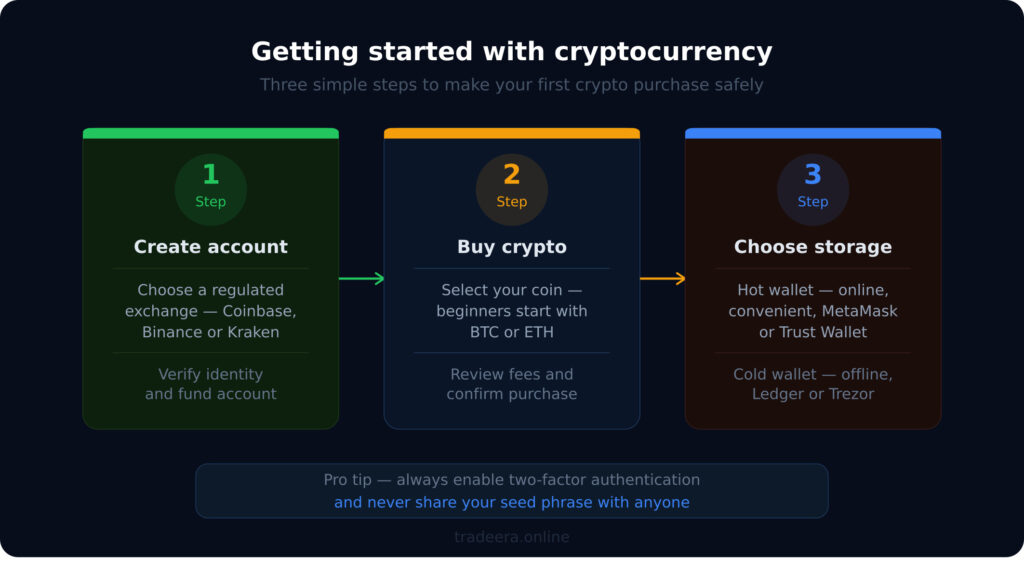
1. Create and Fund Your Account
Choose a regulated cryptocurrency exchange such as Coinbase, Binance, or Kraken. Sign up with your email, complete identity verification, and fund your account using a bank transfer, debit card, or credit card.
2. Buy Crypto
Navigate to the trading section, select the cryptocurrency you want to purchase, enter your desired amount, review the fees, and confirm the transaction. For beginners, starting with Bitcoin or Ethereum is the most straightforward option.
3. Select a Storage Method
After purchasing crypto you have two main storage options:
- Hot wallet — Software wallets connected to the internet such as MetaMask or Trust Wallet. Convenient but more vulnerable to hacks
- Cold wallet — Hardware devices like Ledger or Trezor that store your crypto offline. Much more secure for larger amounts
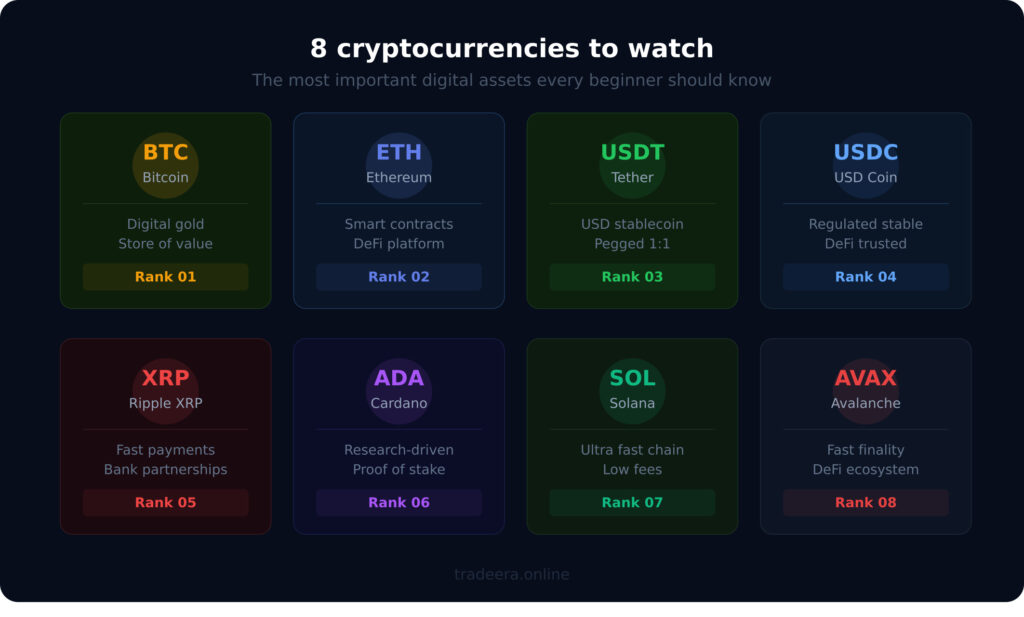
8 Cryptocurrencies to Watch
1. Bitcoin (BTC)
The world’s first and largest cryptocurrency by market cap. Bitcoin is widely considered digital gold and a long-term store of value with a fixed supply of 21 million coins.
2. Ethereum (ETH)
The leading blockchain for smart contracts and decentralized applications. Ethereum powers the majority of the DeFi and NFT ecosystem and has a massive developer community.
3. Tether (USDT)
The most widely used stablecoin, pegged 1:1 to the US dollar. Tether is primarily used for trading and transferring value without exposure to crypto volatility.
4. USD Coin (USDC)
A fully regulated stablecoin backed by US dollars held in reserve. USDC is widely trusted for DeFi applications and institutional use due to its transparency and compliance.
5. XRP (XRP)
Developed by Ripple, XRP is designed for fast and low-cost international money transfers. It has established partnerships with major financial institutions worldwide.
6. Cardano (ADA)
A research-driven blockchain focused on security, sustainability, and scalability. Cardano uses a Proof of Stake consensus mechanism and has a strong academic development approach.
7. Solana (SOL)
One of the fastest blockchains available, capable of processing thousands of transactions per second at very low fees. Solana is a major platform for DeFi, NFTs, and decentralized applications.
8. Avalanche (AVAX)
A highly scalable blockchain designed to offer fast transaction finality. Avalanche supports custom blockchain networks and has become a popular platform for DeFi projects.
Considering a Career in Cryptocurrency?
The crypto industry is creating thousands of new jobs across blockchain development, smart contract engineering, DeFi protocol design, crypto compliance, marketing, and community management. Skills in Solidity programming, blockchain architecture, tokenomics, and Web3 development are in strong demand. Whether you are a developer, analyst, marketer, or legal professional — there is a growing place for you in the blockchain economy.
The Bottom Line
Cryptocurrency represents a genuinely new way of thinking about money, ownership, and financial systems. Understanding how it works — from blockchain technology to wallets, mining, and market dynamics — is the essential first step before making any investment decisions.
Start small, learn continuously, use regulated platforms, and always protect your private keys. The crypto space moves fast but with the right knowledge, you can navigate it confidently and safely.
⚠️ Risk Warning: Cryptocurrency investments are highly volatile and speculative. The value of digital assets can fall as well as rise dramatically. Never invest more than you can afford to lose. Always conduct your own research and consider seeking independent financial advice before investing.
💡 Tip: Before putting real money into any cryptocurrency, practice tracking price movements and studying blockchain projects for at least 30 days. Understanding market cycles before investing is one of the smartest moves a beginner can make.
This article is for educational purposes only and does not constitute financial advice. Trade Era — Your Trusted Source for Trading Education.