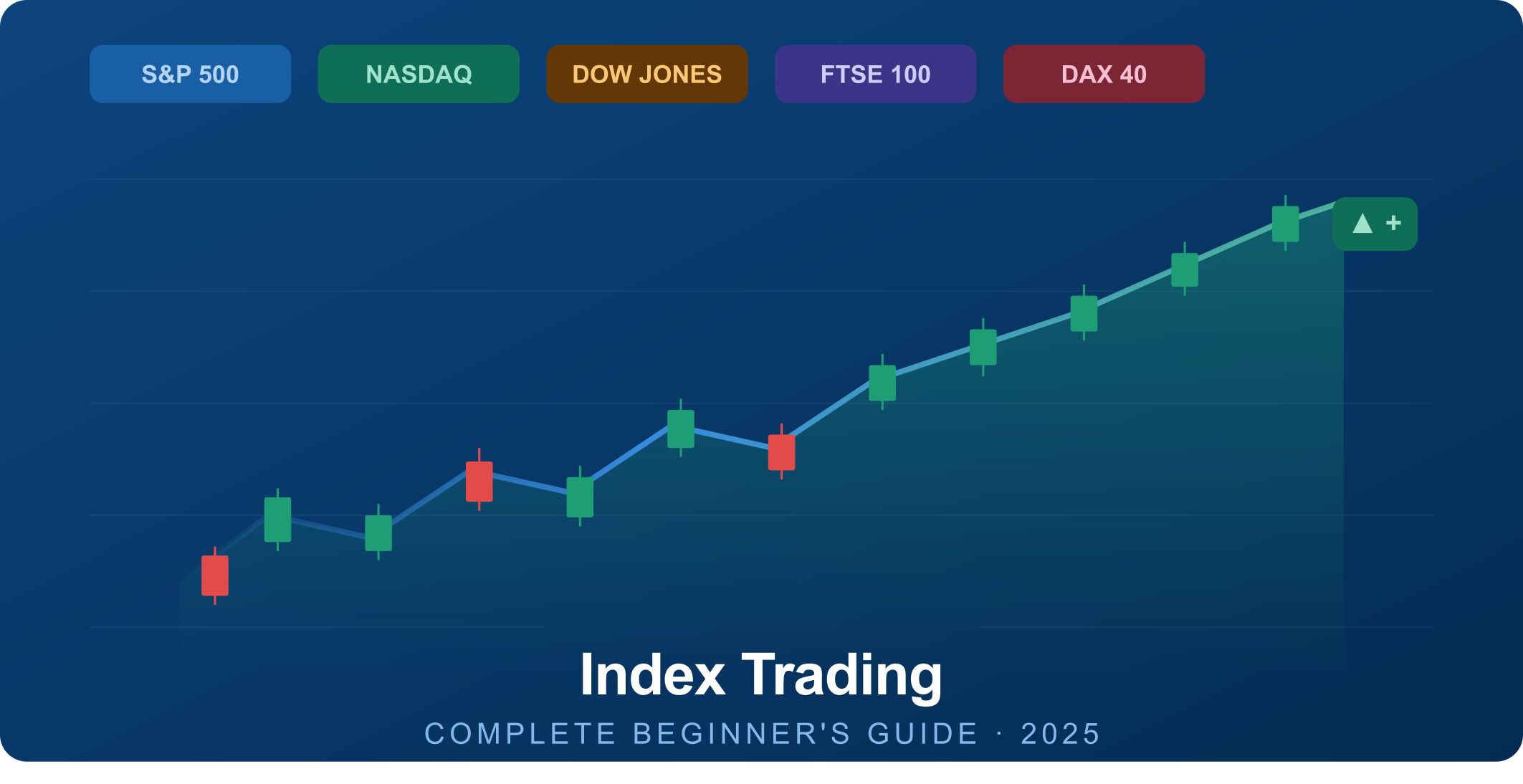
Whether you’re new to financial markets or looking to diversify your trading approach, index trading offers one of the most accessible and balanced ways to participate in global markets. Instead of betting on a single company’s performance, you trade the pulse of entire economies — and that changes everything.
This guide covers what index trading is, how it works, the best strategies, popular indices, and the top platforms to get started.
What is Index Trading and How Does it Work?
Index Trading Defined
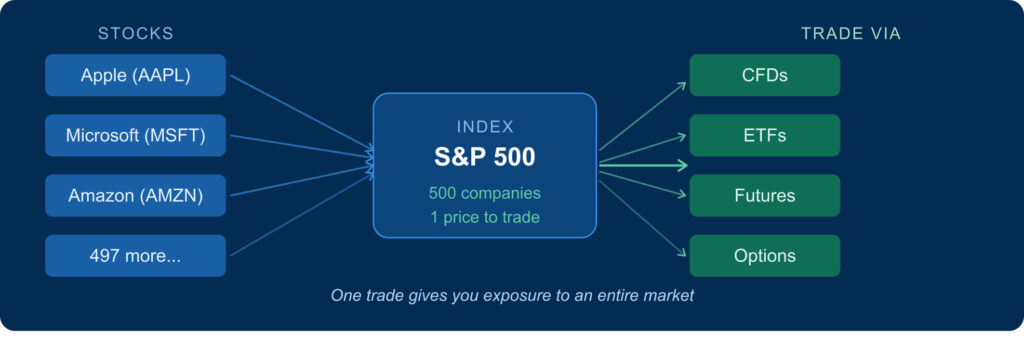
A stock market index is a statistical measure that tracks the performance of a selected group of stocks. Think of it as a basket containing multiple shares — when the companies inside that basket collectively move up or down, the index moves with them.
Index trading, therefore, means taking a position on the price movement of that basket — not buying the shares themselves. When traders engage in index trading, they’re speculating on whether the index will rise or fall, using financial instruments like CFDs, ETFs, or futures contracts.
The concept dates back to 1896, when Charles Dow created the Dow Jones Industrial Average — the world’s first modern stock index. Today, the global index trading market is worth an estimated $8.7 trillion, with index-related derivatives making up a significant portion of daily trading volume worldwide.
Reasons Why Index Trading Is Good for You
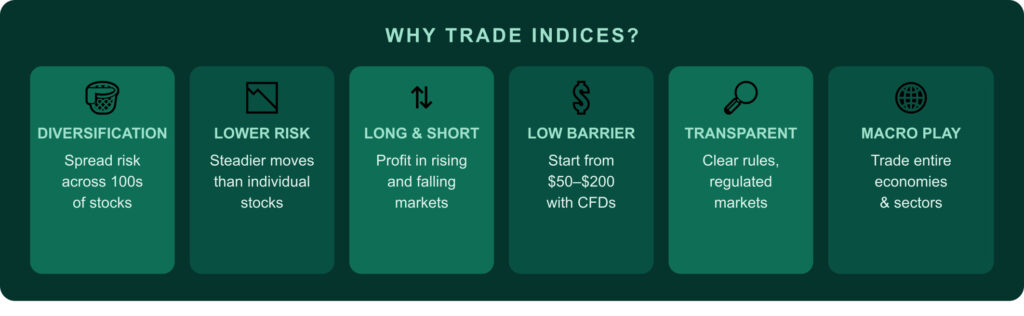
Index trading has grown in popularity for good reason. Here’s why traders across the globe are choosing indices over individual stocks:
- Built-in diversification — You get exposure to dozens or hundreds of companies in a single trade, naturally spreading your risk.
- Lower volatility — Indices tend to move more steadily than individual stocks. One company’s bad news doesn’t tank your entire position.
- Go long or short — With CFDs, you can profit from both rising and falling markets, giving you more flexibility.
- Low capital barrier — You can start trading index CFDs with as little as $50–$200, depending on your broker, versus thousands needed to buy all constituent stocks.
- Transparent and regulated markets — Major indices like the S&P 500 and FTSE 100 are widely tracked, well-documented, and based on clear rules.
- Macroeconomic exposure — Index movements are tied to economic data, central bank decisions, and geopolitical events — giving trend traders a rich analytical playground.
Different Ways to Trade Indices
There are several instruments you can use to access index markets, each with different risk profiles and mechanics:
| Method | How It Works | Best For |
|---|---|---|
| CFDs (Contracts for Difference) | Speculate on price movements without owning the index | Active traders, short-term strategies |
| ETFs (Exchange-Traded Funds) | Buy a fund that mirrors the index, traded on exchange | Long-term investors, beginners |
| Index Futures | Agree to buy/sell an index at a set price on a future date | Experienced traders, hedging |
| Index Options | Right (not obligation) to buy/sell at a set price | Advanced strategies, hedging |
For most retail traders outside the US, index CFDs are the most common choice. They mirror the price 1:1, allow leverage, and are available at the majority of regulated online brokers.
Index Trading Strategies
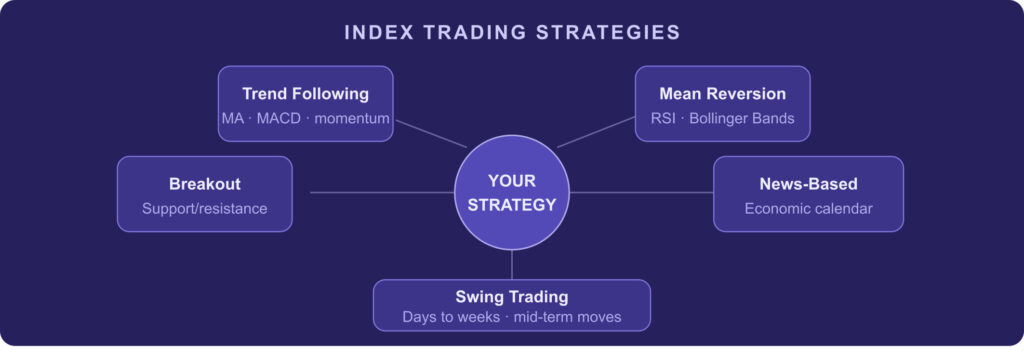
Successful index traders don’t just guess — they follow structured strategies. Here are the most widely used approaches:
1. Trend Following Buy when the index is in an uptrend, sell (short) when it’s in a downtrend. Tools like moving averages and MACD help identify trend direction. This is one of the most beginner-friendly strategies for index trading.
2. Mean Reversion This strategy works on the idea that prices tend to return to their historical average over time. When an index moves far from its mean — for example, the RSI hits above 70 — traders anticipate a reversal. Bollinger Bands are a popular tool here.
3. Breakout Trading When an index breaks above resistance or below support on high volume, it often signals a strong move. Breakout traders enter as the price clears key levels.
4. News-Based (Event-Driven) Trading Central bank announcements, GDP releases, and earnings seasons move indices dramatically. Traders who follow economic calendars can position ahead of or react quickly to these events.
5. Swing Trading Holding positions for a few days to a few weeks to capture medium-term price swings. Ideal for traders who can’t monitor markets all day but want more action than long-term investing.
Risk Management Reminder: Regardless of which strategy you use, never risk more than 1–2% of your capital on a single trade. Use stop-loss orders, size positions carefully, and avoid overleveraging.
How to Calculate Stock Indices
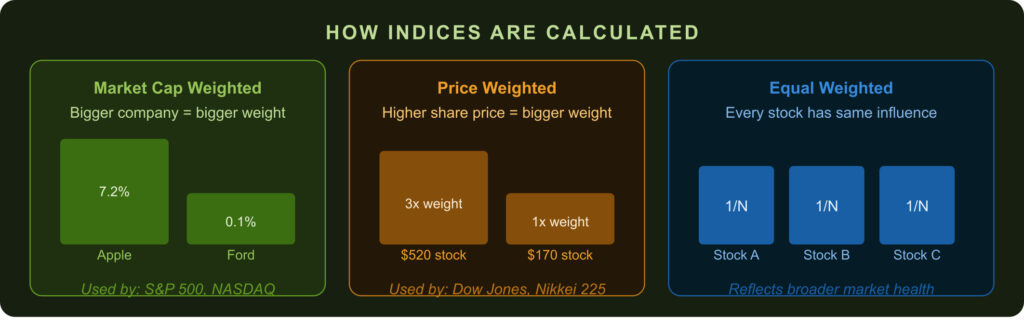
Understanding how index prices are derived helps you interpret market movements more accurately. The three main calculation methods are:
1. Market Capitalisation-Weighted The most common method. Each company’s influence on the index is proportional to its market cap (share price × total shares outstanding). The S&P 500 uses this method, meaning larger companies like Apple and Microsoft have a bigger impact on the index’s movement.
2. Price-Weighted The index value is based purely on stock prices. A higher-priced stock has more influence, regardless of company size. The Dow Jones Industrial Average uses this approach — a $520 stock like UnitedHealth Group carries roughly three times the weight of a $170 stock, even if their market caps are similar.
3. Equal-Weighted Every constituent stock has the same influence. This method gives smaller companies equal footing and often reflects broader market health more evenly.
External Forces that Affect Prices in the Index Market
Index prices don’t move in a vacuum. Several macroeconomic and geopolitical forces drive short- and long-term movements:
- Interest rate decisions — When central banks like the Federal Reserve raise rates, borrowing costs increase and equity markets often fall. Rate cuts generally boost indices.
- Inflation data — High inflation erodes corporate profits and can trigger sell-offs across major indices.
- GDP and employment reports — Strong economic data typically lifts indices; weak data pulls them lower.
- Corporate earnings seasons — Since indices contain company stocks, quarterly earnings results from large constituents can move the whole index.
- Geopolitical events — Wars, trade tensions, and political instability create uncertainty, which often sends indices lower.
- Currency fluctuations — For global indices, a weak domestic currency can boost export-heavy companies and lift the index.
- Commodity prices — Energy and commodity indices are particularly sensitive to oil, gold, and metal price shifts.
Popular Stock Indices for Index Trading
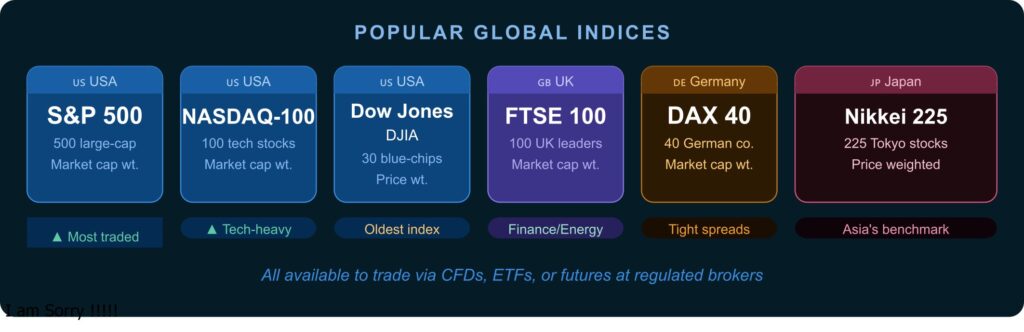
Here’s a quick overview of the world’s most actively traded indices:
| Index | Country | Constituents | Weighting Method |
|---|---|---|---|
| S&P 500 | USA | 500 large-cap stocks | Market cap-weighted |
| Dow Jones (DJIA) | USA | 30 blue-chip stocks | Price-weighted |
| NASDAQ-100 | USA | 100 tech-heavy stocks | Market cap-weighted |
| FTSE 100 | UK | 100 largest UK companies | Market cap-weighted |
| DAX 40 | Germany | 40 major German companies | Market cap-weighted |
| Nikkei 225 | Japan | 225 Tokyo Stock Exchange stocks | Price-weighted |
| Euro Stoxx 50 | Eurozone | 50 blue-chip European stocks | Market cap-weighted |
| Hang Seng | Hong Kong | 82 major HK companies | Market cap-weighted |
Each index reflects the economic health and investor sentiment of its home market, making them useful tools for both local and global macroeconomic analysis.
The Best Indices to Trade for Beginners
If you’re just starting out, not all indices are equal. Here are the most beginner-friendly options and why:
S&P 500 (US500) The gold standard for new traders. It’s highly liquid, well-documented, and moves in response to clear economic events. There’s no shortage of analysis, news, and historical data to help you learn.
NASDAQ-100 (US Tech 100) Perfect for traders who follow the tech sector. It’s more volatile than the S&P 500, which means more opportunity — but also more risk. Better suited once you’ve practiced on the S&P 500 first.
FTSE 100 (UK100) A great choice for UK-based traders or anyone who wants exposure to a major European economy. It’s heavily influenced by financial, energy, and mining sectors.
DAX 40 (GER40) Germany’s benchmark index is popular among European traders. It’s known for tight spreads at most brokers and reliable price action during European market hours.
The Best Index Trading Platforms You Should Check Out
Choosing the right platform matters as much as choosing the right index. Here’s what to look for and some of the top-rated options:
What to look for in an index trading platform:
- Tight spreads on major indices
- Fast execution speeds
- Robust charting tools (MT4, MT5, or proprietary)
- Negative balance protection
- Regulatory oversight (FCA, ASIC, CySEC, etc.)
Top Index Trading Platforms in 2025:
| Platform | Best For | Notable Feature |
|---|---|---|
| Pepperstone | Active traders | Tight spreads, MT4/MT5 support |
| AvaTrade | Beginners | Commission-free, AvaProtect insurance |
| Capital.com | Simplicity | Clean UI, easy global index access |
| Plus500 | Casual traders | Commission-free, +Insights tool |
| Exness | Flexibility | MT4/MT5, user-friendly for CFDs |
| IG Markets | Professionals | Deep liquidity, wide index range |
Always verify that your chosen broker is regulated in your country or region before depositing funds.
Conclusion
Index trading is one of the smartest ways to participate in financial markets — especially if you want diversification, manageable risk, and broad exposure without the complexity of picking individual stocks. Whether you trade the S&P 500 with CFDs or build long-term exposure through ETFs, understanding how indices are constructed, what moves them, and how to manage your risk puts you ahead of the majority of retail traders.
Start small, learn the mechanics, and gradually build your strategy around the index that best matches your market outlook and schedule.
Frequently Asked Questions (FAQs)
Q: What is the minimum amount needed to start index trading? You can start trading index CFDs with as little as $50–$200 at most online brokers, depending on leverage and account minimums.
Q: Is index trading safer than trading individual stocks? Index trading generally carries lower volatility than single stocks because losses in one company are offset by gains in others, though risk is never eliminated.
Q: Can I trade indices 24 hours a day? Index CFDs are typically available 24/5, but price action is sharpest during the index’s official trading hours — for example, 9:30 AM–4 PM EST for US indices.
Q: What is the difference between an index ETF and index CFD? ETFs involve actual ownership of fund units and are better for long-term investing; CFDs are leveraged contracts used for shorter-term speculation without asset ownership.
Q: Do I need trading experience to start index trading? Not necessarily, but learning how indices are calculated, what drives their movements, and how to use stop-loss orders will significantly improve your chances of success.
Q: Which index is best for beginners? The S&P 500 is widely recommended for beginners due to its liquidity, abundant resources, and predictable response to economic events.