Walking into the forex market without a strategy is like driving a motorway blindfolded — fast, dangerous, and avoidable. The good news? You don’t need years of experience or a finance degree to trade intelligently. What you need is the right framework, a rule-based approach, and the discipline to stick to it.
This guide breaks down the top nine forex trading strategies for beginners — what they are, how they work, when to use them, and which one suits your personality, schedule, and risk tolerance. We’ve researched how top-ranking resources approach this topic and distilled the best guidance into one practical, no-fluff article.
In This Article
- What exactly is a trading strategy?
- The 9 most common forex trading strategies
- Quick comparison table
- Advice on choosing the right strategy as a beginner
- Frequently asked questions
What Exactly Is a Trading Strategy?
A forex trading strategy is a structured, repeatable set of rules that tells you when to enter a trade, when to exit, how much to risk, and which currency pairs to watch. It removes guesswork from the equation and replaces panic with process.
Without one, traders react emotionally to price swings — buying out of fear of missing out and selling in a panic when things dip. With a clearly defined strategy, you make the same disciplined decision whether the market is calm or chaotic.
Key insight: A strategy doesn’t need to be complicated to work. In fact, the best strategies for beginners are simple enough to follow consistently under stress. Complexity is the enemy of execution.
What Are the Most Common Trading Strategies?
Below are the nine primary forex trading strategies used by retail traders worldwide. Each one suits a different personality, time commitment, and market condition.
1 News Trading
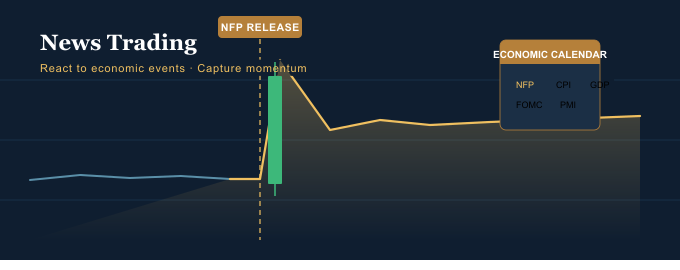
The forex market reacts dramatically to economic announcements — think Non-Farm Payrolls, central bank interest rate decisions, GDP releases, and CPI data. News trading involves anticipating or reacting to these events to capture rapid, high-momentum price moves.
The trick is not to predict the outcome but to react to the price after it settles. Wait for volatility to spike, identify direction, and enter with tight risk controls. Spreads widen heavily around news events, so position sizing matters enormously here.
Timeframe: Minutes–HoursDifficulty: MediumRisk: High
2 Trend Trading
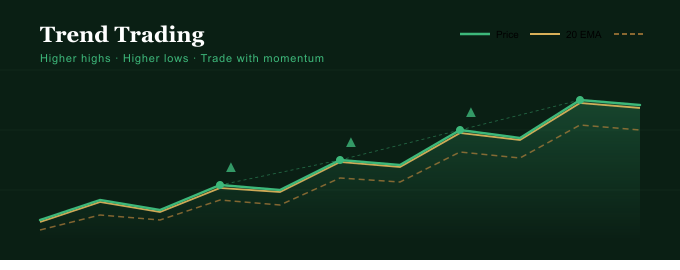
Trend trading is one of the most beginner-friendly strategies because its core rule is simple: trade in the direction the market is already moving. When price makes consistently higher highs and higher lows, that’s an uptrend — buy it. When it makes lower highs and lower lows, it’s a downtrend — sell it.
Tools like moving averages (20 EMA, 50 EMA), RSI, and directional index indicators help confirm the strength and direction of a trend. One of the biggest advantages here is that your entry timing doesn’t have to be perfect — the trend does the heavy lifting.
Timeframe: H4 / DailyDifficulty: Low–MediumRisk: Moderate
3 Range Trading
Markets don’t trend all the time. For large parts of the day, price bounces between a defined floor (support) and ceiling (resistance). Range trading exploits this behaviour — buy near support, sell near resistance, repeat.
Oscillators like RSI and Stochastic are your best friends here. They signal when price is overbought near the top of the range or oversold near the bottom. The strategy breaks down the moment a genuine breakout occurs, so always protect yourself with stop-loss orders placed just outside the range boundaries.
Timeframe: H1–H4Difficulty: LowRisk: Low–Moderate
4 Pattern Trading
Price action leaves footprints. Pattern trading — also called chart pattern or candlestick pattern trading — involves recognising recurring formations that precede predictable moves. Common patterns include head and shoulders, double tops, flags, pennants, and candlestick signals like bullish engulfing or pin bars.
These patterns work because they reflect collective human psychology at specific price levels. A bullish engulfing on the EUR/USD daily chart, for example, has historically produced meaningful up-moves. Combine pattern signals with a broader trend context for higher-probability setups.
Timeframe: H1–DailyDifficulty: MediumRisk: Moderate
5 Breakout Trading
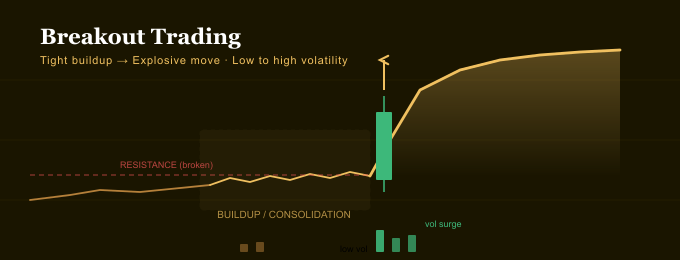
When price has been coiling in a tight range for an extended period (low volatility), the eventual escape — the breakout — can produce explosive, directional moves. Breakout traders position themselves at the edge of consolidation zones, entering once the price clears a defined level with momentum.
The key challenge is “fakeouts” — false breaks that snap back into the range. A useful filter is waiting for price to consolidate (a “buildup”) just below resistance before breaking, which creates a logical, tight stop-loss placement point and a far more favourable risk-to-reward ratio.
Timeframe: H1–DailyDifficulty: MediumRisk: Moderate–High
6 Macro Trading
Macro trading is driven by big-picture economic themes rather than chart patterns. Traders analyse factors like interest rate differentials, geopolitical shifts, central bank policy, and trade balances to predict long-term currency direction.
This is a more sophisticated approach suited to patient traders who enjoy fundamental analysis. A macro trader might hold a position for weeks or months based on their conviction that, say, the US Federal Reserve will pivot on rates while the ECB holds firm.
Timeframe: Daily–WeeklyDifficulty: HighRisk: Moderate
7 Carry Trading
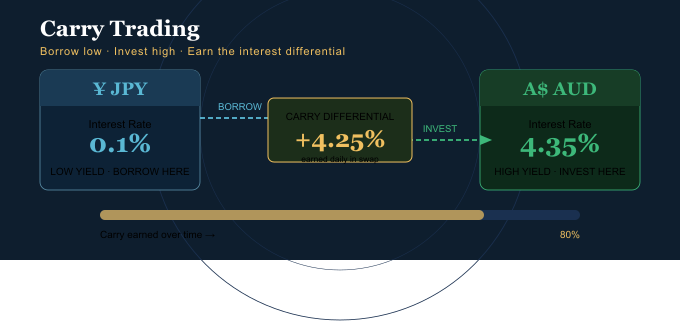
A carry trade involves borrowing in a low-interest-rate currency and investing in a higher-yielding one — pocketing the interest rate differential (called the “carry”) while the position is open. Classic carry pairs include AUD/JPY or NZD/JPY, where the yen serves as a low-rate funding currency.
This strategy works beautifully in calm, risk-on environments but unravels quickly during market stress when traders rush to unwind positions. Risk management and awareness of global sentiment are non-negotiable here.
Timeframe: Weekly–MonthlyDifficulty: Medium–HighRisk: Moderate
8 Contrarian Trading
Where most traders see momentum, contrarian traders see exhaustion. This strategy involves fading the crowd — going long when sentiment is overwhelmingly bearish, or short when euphoria peaks. The logic is that extreme positioning creates the very conditions for reversal.
Contrarian trading is not for the faint-hearted. Markets can remain irrational longer than you can remain solvent, as the saying goes. It requires strong conviction, wide stops, and careful position sizing. Sentiment indicators, commitment of traders (COT) reports, and extreme RSI readings guide entries.
Timeframe: H4–WeeklyDifficulty: HighRisk: High
9 Mean Reversion Trading
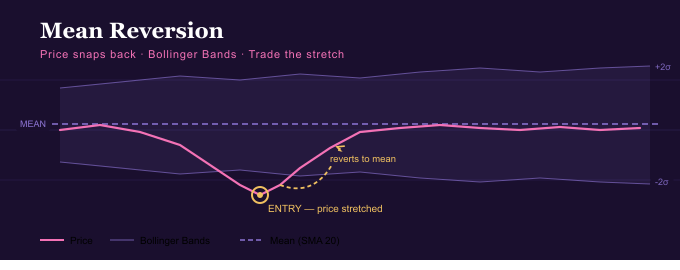
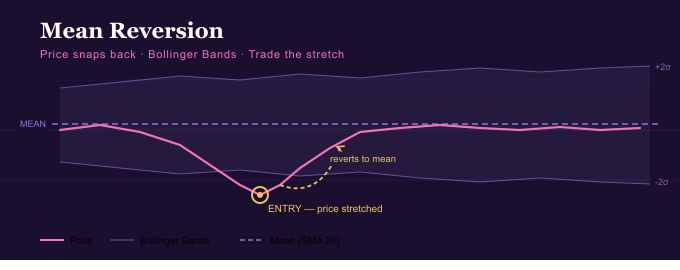
The premise of mean reversion is that price, like a rubber band, tends to snap back toward its average after stretching too far. When a currency pair deviates significantly from its statistical mean — as measured by Bollinger Bands, z-scores, or moving average distance — a reversion trade bets on a return to equilibrium.
It pairs well with range trading and works best in sideways, low-trend environments. Avoid applying it in strongly trending markets, where price may keep moving away from the mean for far longer than expected.
Timeframe: H1–H4Difficulty: MediumRisk: Low–Moderate
Quick Strategy Comparison Table
| Strategy | Best For | Timeframe | Tools Needed | Beginner Rating |
|---|---|---|---|---|
| News Trading | Active traders around data events | M1–H1 | Economic calendar | ⭐⭐⭐ |
| Trend Trading | Patient beginners | H4 / Daily | EMA, RSI | ⭐⭐⭐⭐⭐ |
| Range Trading | Beginners in sideways markets | H1–H4 | RSI, Stochastic | ⭐⭐⭐⭐⭐ |
| Pattern Trading | Visual, chart-focused traders | H1–Daily | Candlestick charts | ⭐⭐⭐⭐ |
| Breakout Trading | Momentum seekers | H1–Daily | ATR, volume | ⭐⭐⭐⭐ |
| Macro Trading | Fundamental analysts | Daily–Weekly | Macro data, news | ⭐⭐ |
| Carry Trading | Long-term, income-focused traders | Weekly–Monthly | Swap rates, macro data | ⭐⭐⭐ |
| Contrarian Trading | Experienced, high-conviction traders | H4–Weekly | COT reports, RSI | ⭐⭐ |
| Mean Reversion | Range-bound market specialists | H1–H4 | Bollinger Bands | ⭐⭐⭐⭐ |
Advice on Which Trading Strategy Is Best for Beginners
There is no universally “best” forex trading strategy. The right strategy is the one you can execute consistently and calmly — not the one with the highest theoretical return. Here’s a practical framework to help you choose:
Consider Your Available Time
If you can sit at a screen for two to four hours during the London or New York session, day trading with trend or breakout strategies suits you. If you’re juggling a job or other commitments, swing trading on the H4 or Daily chart with a trend-following approach is far more realistic.
Start With One Strategy, Not Several
One of the most common beginner mistakes is jumping between strategies every time one produces a losing trade. Stick with a single strategy for at least 30 to 50 trades before judging its merit. You cannot assess edge from three trades — the sample size is statistically meaningless.
Master Risk Management First
No strategy works without sound risk management. Follow these core principles before you place your first live trade:
- Never risk more than 1–2% of your account on a single trade
- Always use a stop-loss order — no exceptions
- Aim for a minimum risk-to-reward ratio of 1:1.5 or higher
- Keep a trading journal to track your entries, exits, and emotional state
- Trade a demo account for at least 60 days before going live
Match Strategy to Personality
If fast-paced decision-making excites you, breakout or news trading may fit. If you prefer deliberate analysis and don’t mind holding through short-term noise, trend trading or carry trading will feel more natural. Trading against your personality leads to emotional decisions — and emotional decisions lead to losses.
Expert tip: For most beginners, trend trading on the H4 or Daily chart using the 20 and 50 EMA is the ideal starting point. It’s rule-based, visual, requires minimal analysis, and teaches the most important trading skill — patience.
Final Thoughts
The forex market rewards preparation, discipline, and consistency — not luck or complexity. Whether you choose to trend-follow on the daily chart or fade extremes with a mean reversion approach, the foundation is always the same: a clear plan, defined risk, and the emotional discipline to follow both.
Start with a demo account. Pick one strategy. Track every trade. And give yourself the time to develop a genuine edge before risking real capital. The traders who succeed long-term are not the ones who found a magic indicator — they’re the ones who found a process that fits them, and stuck to it.
Frequently Asked Questions
What is the easiest forex trading strategy for beginners?
Trend trading using moving averages (20 EMA / 50 EMA) on the H4 or Daily timeframe is widely considered the most beginner-friendly — it’s rule-based, visual, and teaches core trading discipline.
Is there a 100% winning forex strategy?
No. Every strategy has losing trades — the goal is to ensure winning trades outsize losing ones and that your risk management keeps losses small and manageable.
How long does it take to learn forex trading?
Most traders need six to twelve months of consistent demo trading before developing a reliable edge — patience and structured learning dramatically shorten the curve.
What is the best forex trading strategy for consistent profits?
Consistent profitability comes from disciplined execution of any sound strategy combined with strict risk management, not from finding a “special” method.
Should beginners use fundamental or technical analysis?
Most beginners start with technical analysis (charts, indicators, price action) as it’s more visual and rule-based; adding fundamental awareness of major news events enhances results over time.
How much capital do I need to start forex trading?
Many brokers allow you to open accounts with as little as $100–$500, but a starting capital of $1,000–$5,000 gives you more flexibility to manage risk responsibly.
What is carry trading in forex?
Carry trading means borrowing in a low-interest-rate currency and holding a higher-yielding one to earn the interest rate differential — profits accumulate daily while the position is open.
Can I combine multiple forex trading strategies?
Yes, but only after mastering one strategy first. Experienced traders often combine trend-following for directional moves with range or mean reversion methods during consolidation phases.
What is a stop-loss and why is it important?
A stop-loss is a pre-set exit point that limits your loss on any trade — it’s the single most important risk management tool in a beginner trader’s kit.
What currency pairs are best for beginners?
Major pairs like EUR/USD, GBP/USD, and USD/JPY are ideal for beginners due to high liquidity, tight spreads, and abundant educational resources and analysis available.