Ask any professional trader what the single most important lesson they ever learned was, and nine times out of ten the answer comes back to risk management — specifically, how much to risk on each individual trade.
How Much Should You Risk per Trade? New traders almost universally make the same mistake: they risk too much. A few big losses wipe out weeks of careful gains, confidence disappears, and emotional decision-making takes over. Understanding exactly how much to risk per trade is not just important — it is the foundation that everything else in trading is built upon.
This guide gives you the complete picture — from the core principles to the exact formulas you can apply right now.
Goal of This Lesson
By the end of this guide you will understand:
- Why risking too much destroys accounts even with a good strategy
- How the 1% rule works and why it is the industry standard
- How to calculate your exact position size for any trade
- How compounding small consistent gains builds long-term wealth
- How to protect your account with daily and weekly loss limits
Basic Position Sizing Principles
1. Risking Too Much Creates Emotional and Financial Pressure
When your position size is too large, something predictable happens — you stop making rational decisions and start making emotional ones.
Oversized positions magnify both fear and greed. When a trade goes against you and you are down $500 on a $1,000 account, the emotional pressure to cut the loss, move your stop, or revenge trade becomes overwhelming. This is not a willpower problem. It is a position sizing problem.
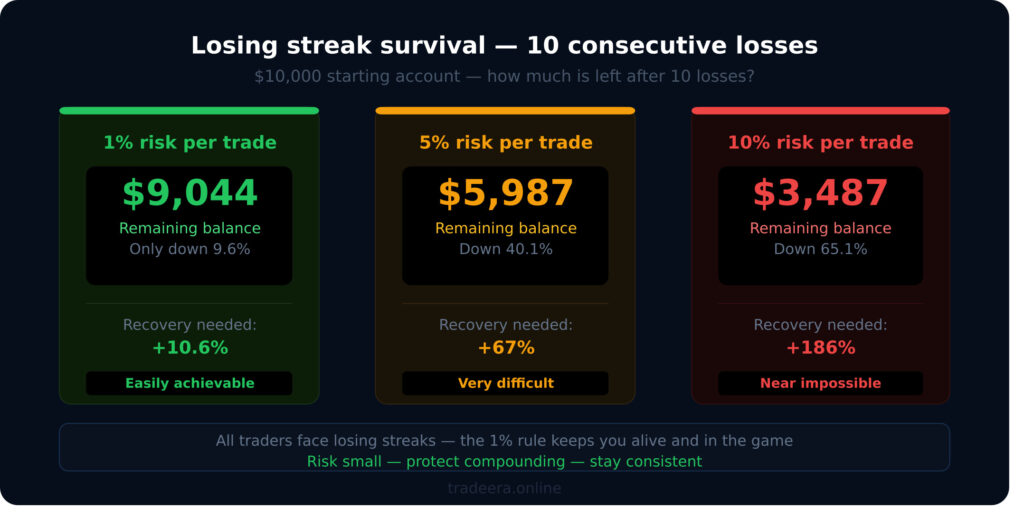
The mathematical reality is brutal. Consider what happens when you risk 10% per trade on a losing streak:
| Risk Per Trade | After 10 Consecutive Losses | Recovery Needed |
| 10% | Account down 65% | +186% to recover |
| 5% | Account down 40% | +67% to recover |
| 2% | Account down 18% | +22% to recover |
| 1% | Account down 10% | +11% to recover |
The 1% trader still has 90% of their capital after 10 straight losses. The 10% trader needs nearly double their remaining balance just to break even. Small risk is not timid — it is strategically smart.
2. Compounding is the Path to Long-Term Growth
Here is a concept that most beginners completely miss: small consistent gains compounded over time create extraordinary results.
A $10,000 account growing at just 2% per month compounds to over $14,800 in 24 months — without a single extraordinary trade. The key word is “compounding” — your returns are calculated on a growing base, so each percentage gain is worth more in absolute dollars than the last.
Over-risking destroys compounding. One large loss at 10% per trade costs you the equivalent of ten months of 1% gains. Protect compounding by protecting your capital.
3. The Standard Benchmark — 1% per Trade
The 1% rule is the most widely respected risk management benchmark in professional trading. It means you never risk more than 1% of your total account balance on any single trade.
The formula is simple:
Account Balance × 1% = Maximum Risk per Trade
| Account Size | 1% Max Risk | 2% Max Risk |
| $1,000 | $10 | $20 |
| $5,000 | $50 | $100 |
| $10,000 | $100 | $200 |
| $25,000 | $250 | $500 |
| $50,000 | $500 | $1,000 |
At 1% risk, you can survive over 100 consecutive losing trades before your account is significantly damaged. This gives you the runway to recover, adapt, and improve — which is exactly what developing traders need.
4. Lower Risk if You are New or Struggling
If you are a beginner or currently going through a losing streak, reducing risk to 0.5% or even 0.25% per trade is not weakness — it is wisdom.
At 0.5% risk you are reducing financial pressure enough to trade more clearly. You can focus on executing your strategy correctly without the weight of large dollar losses clouding your judgement. Once you see consistent profitability over two to three months of live trading, gradually move back toward 1%.
5. Adjust Risk as Your Account and Skills Grow
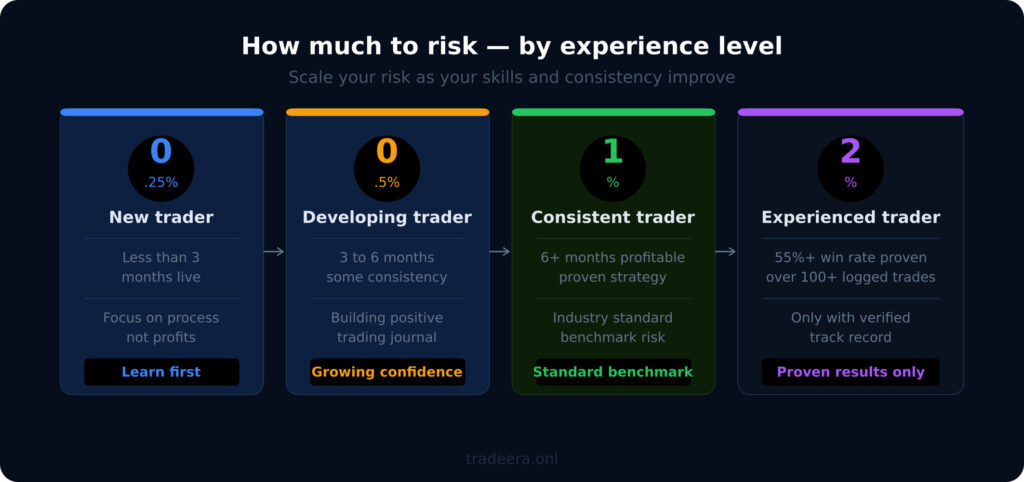
Risk should not be a static number — it should evolve with your demonstrated ability and account size. The progression looks like this:
- Complete beginner — 0.25% to 0.5% per trade
- Developing trader with 3+ months of demo results — 0.5% to 1% per trade
- Consistent profitable trader with proven track record — 1% per trade
- Experienced trader with verified 55%+ win rate over 100+ trades — consider up to 2%
Moving to 2% per trade should only happen when your trading journal objectively proves your strategy works — not because you feel confident about a particular setup.
6. Higher Risk Does Not Mean Higher Profits
This is perhaps the most counterintuitive truth in trading. Increasing your risk per trade does not reliably increase your net profits — it primarily increases your volatility and the likelihood of catastrophic drawdown.
A trader risking 1% consistently and winning 55% of trades with a 1.5:1 reward ratio will outperform a trader risking 5% per trade with the same win rate over any extended period — because the 5% trader will inevitably hit a losing streak that forces emotional decisions, strategy abandonment, or account damage severe enough to impair their ability to continue trading.
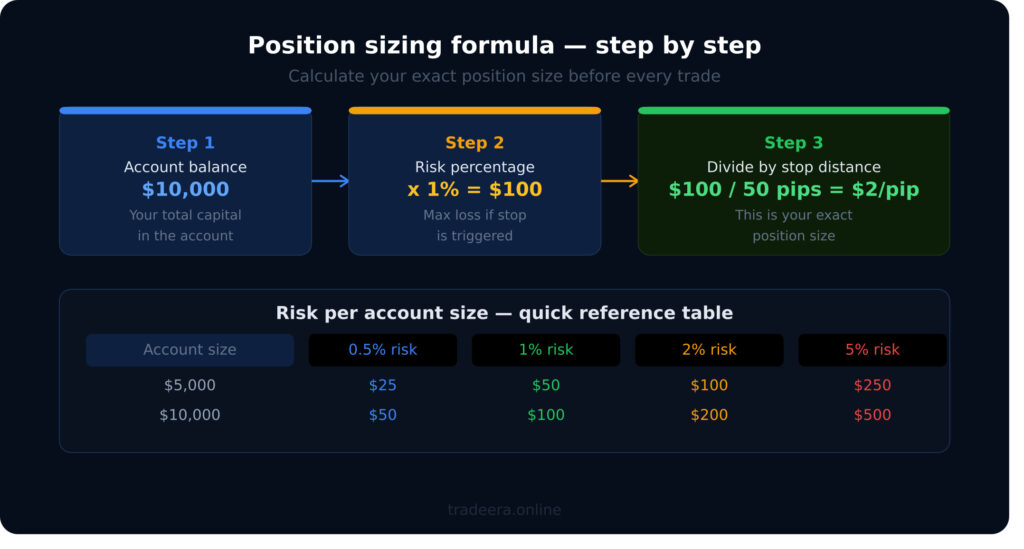
Steps You Can Apply Now
1. Calculate Your Risk in Dollars and Percentages
Before placing any trade, do this calculation:
Step 1: Determine your account balance Step 2: Multiply by 1% (or your chosen risk percentage) Step 3: This is your maximum dollar risk for the trade
Example:
- Account balance: $8,000
- Risk percentage: 1%
- Maximum risk: $8,000 × 0.01 = $80 maximum loss per trade
This $80 is not your position size — it is the maximum amount you are willing to lose if your stop-loss is triggered.
2. Base Your Position Size on Your Stop-Loss Distance
This is where most beginners make a critical error. Position size must be calculated from your stop-loss distance — not from how confident you feel about the trade.
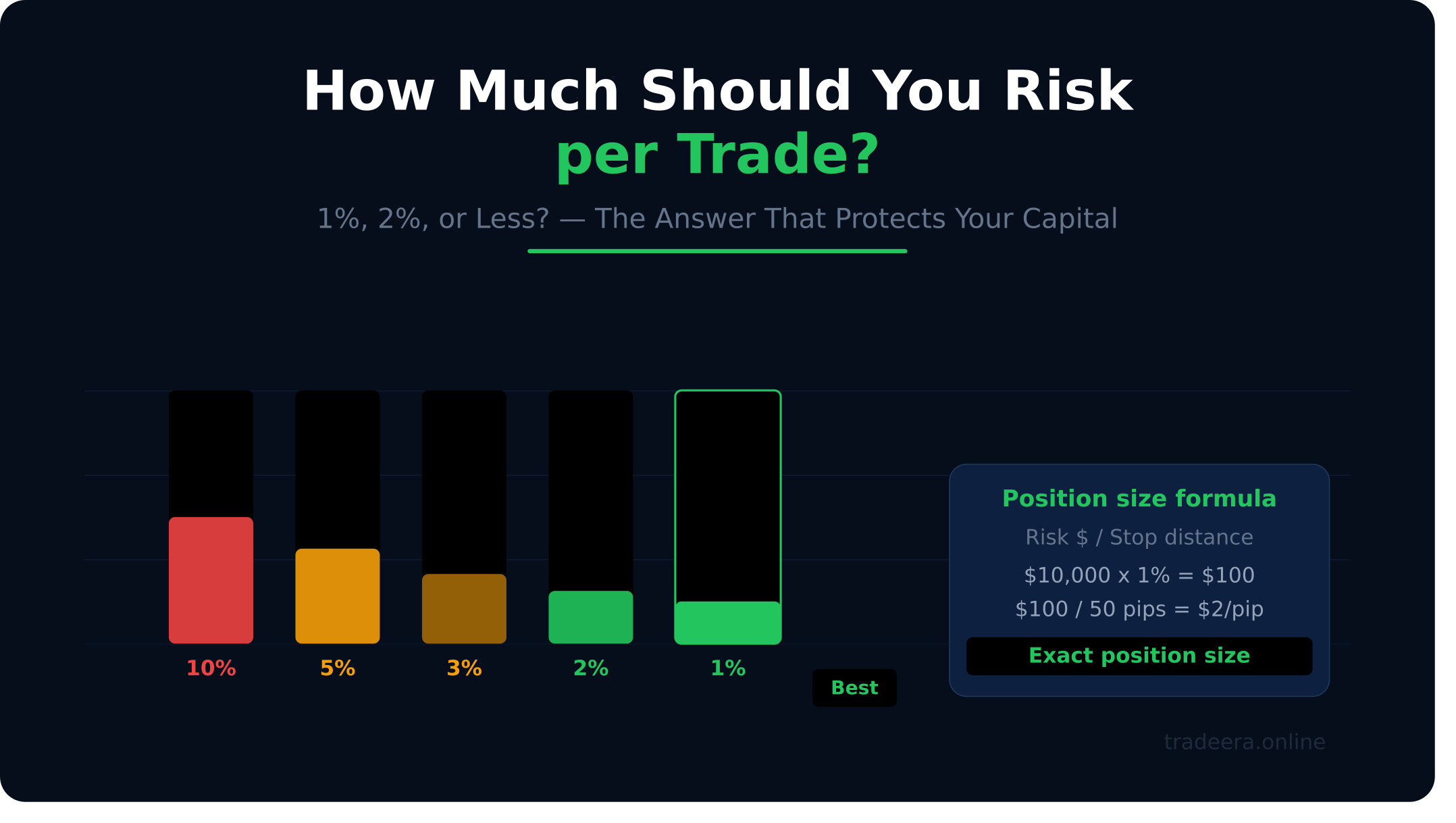
The Position Sizing Formula:
Position Size = Risk Amount ($) ÷ Stop-Loss Distance
Forex Example:
- Account: $8,000
- Risk: 1% = $80
- Stop-loss: 40 pips away
- Position Size: $80 ÷ 40 pips = $2 per pip
- In lot terms: 0.2 mini lots
Stock Example:
- Account: $10,000
- Risk: 1% = $100
- Entry price: $50
- Stop-loss: $47 (distance = $3 per share)
- Position Size: $100 ÷ $3 = 33 shares
If your stop is triggered at $47, you lose exactly $100 — your predetermined maximum. This discipline is what separates consistent traders from gamblers.
3. Protect Your Compounding by Limiting Daily and Weekly Losses
Individual trade risk management is only part of the picture. You also need session-level guardrails:
- Daily loss limit — stop trading when you have lost 1 to 1.5% of your account in a single day
- Weekly loss limit — step back and review when weekly losses reach 4 to 5% of your account
- Consecutive loss rule — after three losses in a row, pause for at least 30 minutes before continuing
These limits exist because trading quality degrades rapidly after consecutive losses. Fatigue, frustration, and the urge to “win it back” lead to larger position sizes, wider stops, and trades that violate your plan. The daily limit protects your capital and your mental state simultaneously.
4. Review Past Trades to See if Your Risk is Too High
Your trading journal is the most honest feedback mechanism available to you. Look back at your last 20 to 30 trades and ask:
- How did I feel during my losing trades? Did I feel panic, anxiety, or overwhelming pressure?
- Did I move stop-losses to avoid being stopped out?
- Did I take revenge trades after a loss?
- Did I close winning trades too early out of fear?
If the answer to any of these is yes, your risk per trade is too high — regardless of what percentage it represents. The right risk level is one where you can execute your plan unemotionally through both winning and losing streaks.
Key Takeaway
Risk small. Stay consistent. Let compounding do the heavy lifting.
The 1% rule is not a limitation — it is a superpower. It gives you the ability to survive losing streaks, maintain emotional clarity, compound your gains over time, and build a trading career that lasts.
Every professional trader who has built sustainable wealth in the markets arrived at the same conclusion: it is not about how much you make on your best trades. It is about how little you lose on your worst ones.
Start Practicing with Confidence — Risk-Free
The best way to get comfortable with position sizing calculations before using real money is through a demo account. Practice calculating your risk in dollars, working out your position size from your stop-loss, and keeping a trading journal for every entry. Once these calculations become automatic and your results are consistent, then — and only then — transition to a live account with the lowest viable risk percentage.
FAQs
What is the 1% rule in trading?
The 1% rule means never risking more than 1% of your total account balance on a single trade. On a $10,000 account this means a maximum loss of $100 per trade.
Is 2% risk per trade too much for beginners?
Yes — beginners should start at 0.25% to 0.5% per trade. The 2% level is only appropriate for experienced traders with a proven and documented track record.
How do I calculate my position size?
Divide your maximum dollar risk (account balance × risk %) by your stop-loss distance in pips or dollars. This gives your exact position size or number of shares.
What happens if I risk 10% per trade?
After just 10 consecutive losses at 10% risk, your account drops by 65% and you need a 186% return just to break even. This is why professional traders consider 10% risk per trade catastrophic.
Should I risk more on high-confidence trades?
No. Position sizing should be based on your system rules — not on how confident you feel about any individual trade. Overconfidence is one of the most common causes of trading account blowups.
What is a daily loss limit?
A daily loss limit is a self-imposed rule to stop trading once your account has lost 1 to 1.5% in a single session. It protects your capital from emotionally-driven over-trading after a bad day.
Can I increase my risk as my account grows?
Yes — but only because the same percentage becomes a larger absolute dollar amount as your account grows, not because you change the percentage. Keep your risk percentage consistent and let compounding do the work.
Disclaimer
This article is for educational purposes only and does not constitute financial advice. Trading involves significant risk of loss. Always apply proper risk management and never trade with money you cannot afford to lose. Past performance is not indicative of future results.
Trade Era — Your Trusted Source for Trading Education