What Is Risk Management in Trading?
Most traders focus obsessively on finding the perfect entry. They spend hours studying charts, scanning for signals, and back-testing strategies. Yet the traders who actually survive long-term share one quiet habit: they manage risk before they think about profit.
Risk management in trading is a structured system of rules and tools designed to protect your capital from severe, account-damaging losses. It tells you how much to risk on each trade, where to exit when you’re wrong, and how to stay in the game long enough to let your edge play out.
Simply put, it is the process of identifying, evaluating, and controlling potential financial loss across every trade you take.
Featured Snippet Answer: Risk management in trading is the practice of controlling potential losses using structured tools like stop-loss orders, position sizing, risk-to-reward ratios, and diversification — allowing traders to survive losing streaks and stay profitable over time.
Why Risk Management Matters
Here is an uncomfortable truth: even the best trading strategy will produce losing trades. Markets are inherently unpredictable. No signal is 100% accurate. What separates long-term profitable traders from those who blow up their accounts is not a better strategy — it is better risk control.
Consider this math:
| Account Loss | Recovery Needed |
|---|---|
| 10% loss | 11% gain to recover |
| 25% loss | 33% gain to recover |
| 50% loss | 100% gain to recover |
| 75% loss | 300% gain to recover |
The deeper your drawdown, the harder it becomes to recover. Risk management prevents small losses from turning into catastrophic ones.
Beyond math, effective risk management:
- Keeps you emotionally stable during losing streaks
- Allows you to stay in the market long enough to capitalize on opportunities
- Turns trading from gambling into a disciplined, repeatable process
- Protects your capital — the fuel your trading machine runs on
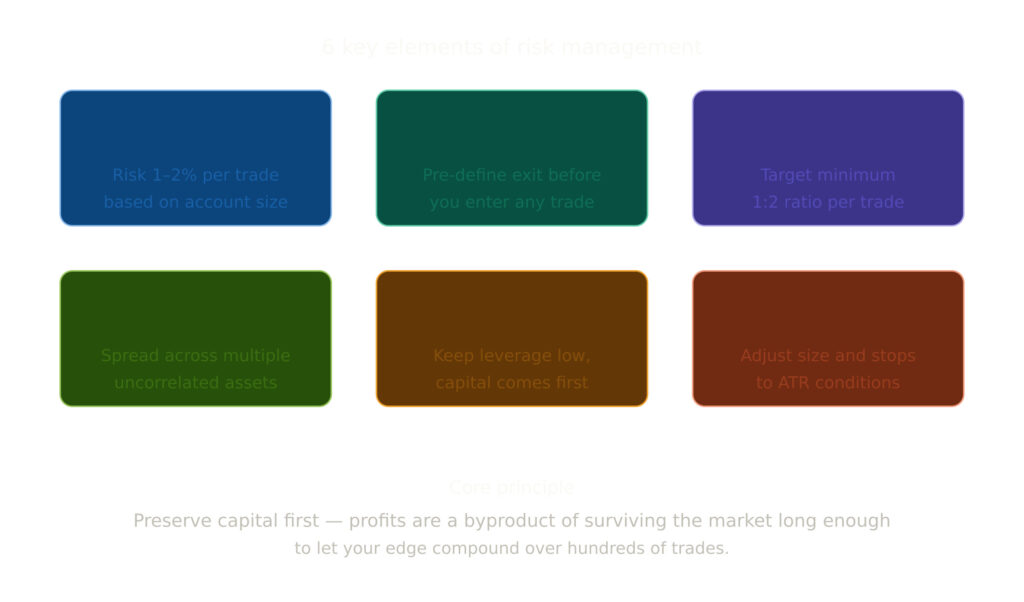
Key Elements of Risk Management
1. Position Sizing
Position sizing answers the question: how much of my capital should I put into this one trade?
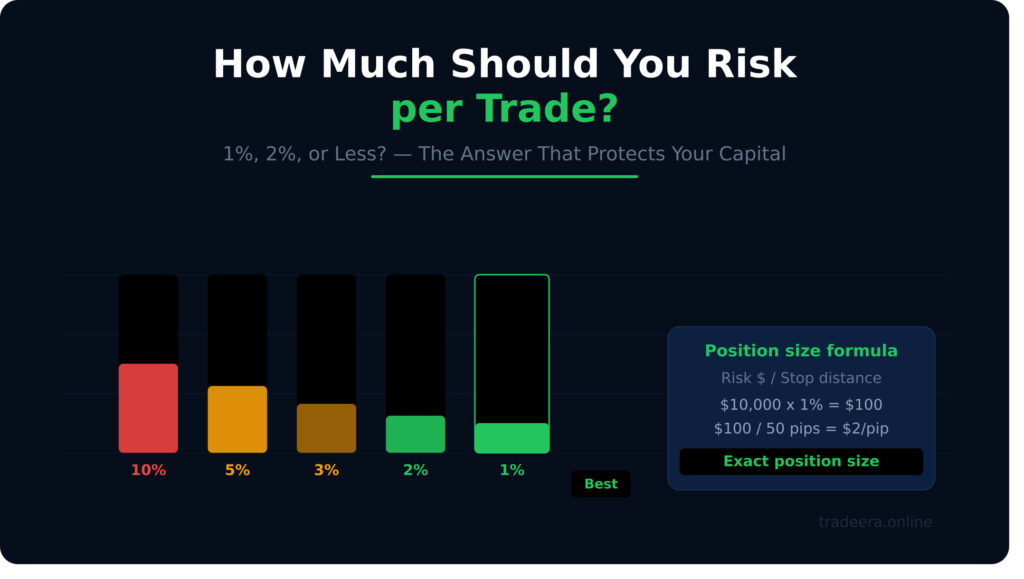
Most professional traders follow the 1–2% rule — never risk more than 1–2% of your total account on any single trade. If you have a $10,000 account and follow the 2% rule, the maximum you risk per trade is $200.
This approach ensures that even a string of 10 consecutive losses will not wipe you out. It gives your strategy enough runway to recover.
How to calculate position size:
Position Size = (Account Size × Risk %) ÷ (Entry Price − Stop-Loss Price)
Example:
- Account: $10,000
- Risk per trade: 2% = $200
- Entry: $50.00 | Stop-loss: $48.00 → Risk per share = $2.00
- Position size = $200 ÷ $2.00 = 100 shares
Matching position size to your stop distance (rather than using a fixed share count) keeps your actual dollar risk consistent across different instruments and setups.
2. Stop-Loss Orders
A stop-loss is a pre-defined exit point — the price level where you admit the trade is wrong and exit to limit your loss.
Without a stop-loss, a single bad trade can devastate an account. With one, your maximum loss on any trade is known before you even enter.
Types of stop-loss strategies:
| Type | How It Works | Best For |
|---|---|---|
| Fixed percentage | Always stop X% below entry | Beginners, simple setups |
| Technical (support/resistance) | Stop placed below a key level | Swing traders, chart-based traders |
| ATR-based | Stop = Entry − (N × Average True Range) | Volatile instruments |
| Trailing stop | Moves with price to lock in gains | Trend-following strategies |
Key tip: Place your stop at a technically logical level — just below support for longs, just above resistance for shorts — rather than at an arbitrary percentage. A stop placed at a meaningful level is less likely to be triggered by normal market noise.
3. Risk-to-Reward Ratio
The risk-to-reward ratio (R:R) compares how much you stand to lose against how much you stand to gain on a trade.
Formula:
R:R = Potential Gain ÷ Potential Loss
Example: If you risk $100 to potentially gain $300, your R:R is 1:3.
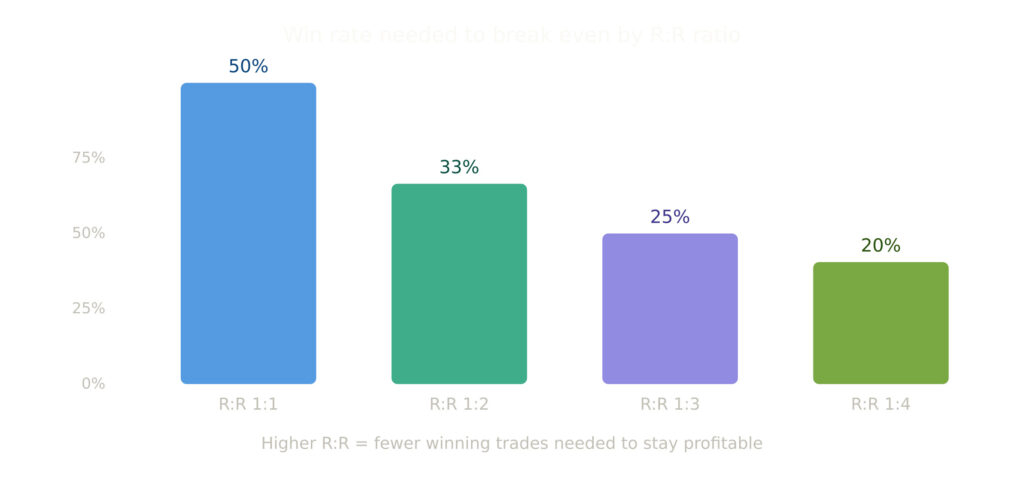
Why does this matter? With a 1:3 ratio, you only need to win 1 in 3 trades to break even. Win 2 in 3, and you’re significantly profitable.
| R:R Ratio | Win Rate Needed to Break Even |
|---|---|
| 1:1 | 50% |
| 1:2 | 33% |
| 1:3 | 25% |
| 1:4 | 20% |
Most experienced traders target a minimum of 1:2, and many prefer 1:3 or higher. A strong R:R ratio means your strategy can still be profitable even when you lose more often than you win.
4. Diversification
Diversification means spreading your risk across multiple uncorrelated assets rather than concentrating it all in one position or sector.
If all your trades are in tech stocks and the sector sells off, your entire portfolio suffers. But if you hold positions in tech, commodities, currencies, and bonds, a downturn in one area is partially offset by stability or gains in another.
Effective diversification involves:
- Trading different asset classes (stocks, forex, commodities, crypto)
- Avoiding correlated positions (e.g., holding multiple tech stocks that move together)
- Limiting total exposure to any single sector or theme
- Balancing long and short positions during uncertain markets
Diversification does not eliminate risk — it distributes it intelligently.
5. Avoid Overleveraging
Leverage amplifies both gains and losses. A 10:1 leverage ratio means a 1% move in your favor doubles your position value — but a 1% move against you can wipe out your margin.
Many beginner traders over-leverage because they see the profit potential without properly weighing the risk. This is one of the most common causes of blown trading accounts.
Rules to avoid overleveraging:
- Never use more leverage than your strategy and account size justify
- Treat leverage as a precision tool, not a shortcut to bigger wins
- Reduce leverage during high-volatility events (earnings, central bank meetings, geopolitical news)
- Understand your broker’s margin call thresholds before trading
A conservative approach: if you are unsure how much leverage to use, use less than you think you need. Capital preservation always comes first.
6. Understand Market Volatility
Volatility is the speed and magnitude of price movement. High-volatility markets can trigger stop-losses quickly and produce sharp reversals. Low-volatility markets can lull traders into oversized positions that get punished when volatility returns.
Tools to measure volatility:
- Average True Range (ATR): measures the average daily price range of an asset
- VIX (Volatility Index): tracks expected volatility in the S&P 500
- Bollinger Bands: show price deviation from a moving average
Adjust your strategy to market conditions. In high-volatility environments, widen your stops slightly (to avoid being stopped out by noise), reduce position size, and lower your R:R expectations. In calm markets, tighter stops and larger positions can work effectively.
How to Build a Risk Management Plan
A risk management plan is not a concept — it is a written set of rules you follow before, during, and after every trade. Here is a simple framework:
Step 1 — Define your risk per trade Decide what percentage of your account you are willing to lose on a single trade (typically 1–2%).
Step 2 — Set your stop-loss before entry Before placing any trade, know your exit point. Never enter without a pre-defined stop.
Step 3 — Calculate your position size Use your stop distance and risk percentage to determine how many shares, lots, or contracts to buy.
Step 4 — Check your risk-to-reward Only take trades where potential gain is at least 2× the potential loss.
Step 5 — Set a daily/weekly loss limit Decide in advance the maximum you will lose per day or week. If you hit it, stop trading. Most professionals stop after losing 3% of capital in a single session.
Step 6 — Review and journal every trade Track what worked, what did not, and why. A trade journal transforms experience into data-driven improvement.
| Risk Plan Element | Recommended Setting |
|---|---|
| Max risk per trade | 1–2% of account |
| Minimum R:R ratio | 1:2 |
| Daily loss limit | 3–5% of account |
| Max open positions | 3–5 (depending on strategy) |
| Leverage limit | 2:1 to 5:1 for most traders |
The Psychology of Risk
You can have the most technically perfect risk management plan in the world. But if fear, greed, or frustration make you deviate from it, none of the math matters.
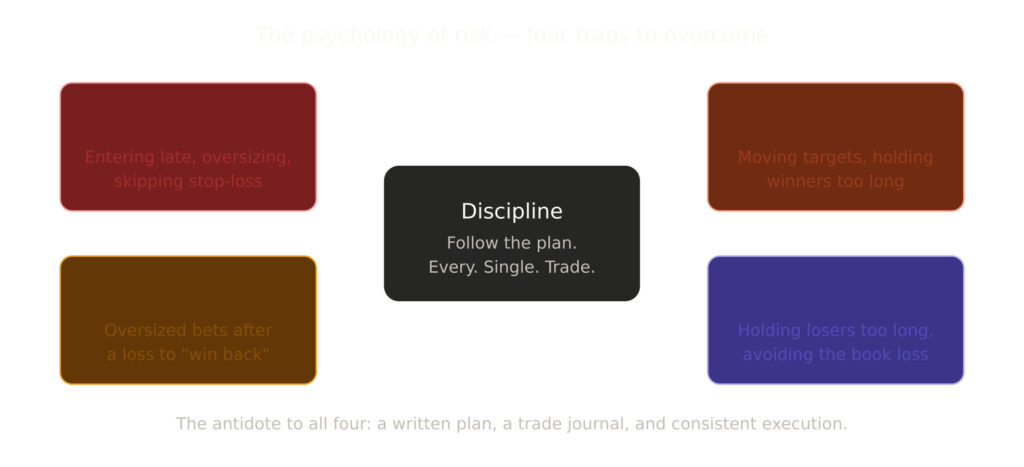
Trading psychology is where most risk plans fall apart. Here is how emotional biases undermine risk management:
- Fear of missing out (FOMO): Causes traders to enter late, oversize positions, or skip their stop-loss
- Revenge trading: After a loss, traders take oversized bets to “win it back” — usually making things worse
- Greed: Moving a profit target further away and tightening a stop-loss in hopes of a bigger win
- Loss aversion: Holding a losing trade too long hoping it will recover, avoiding the pain of booking the loss
How to build psychological resilience:
- Accept that losses are a normal part of trading — they are a cost of doing business
- Focus on executing your plan correctly, not on the outcome of any single trade
- Review your rules before every session and commit to following them regardless of emotion
- Take breaks after significant losses to reset your mental state
- Track your emotional state in your trading journal alongside your trades
The best risk management system is one you can actually follow consistently. Simple, clear rules you stick to beat complex systems you abandon under pressure.
Conclusion
Risk management in trading is not a secondary concern — it is the primary skill that determines whether you succeed or fail in the markets. Profitable strategies fail without it. Average strategies thrive with it.
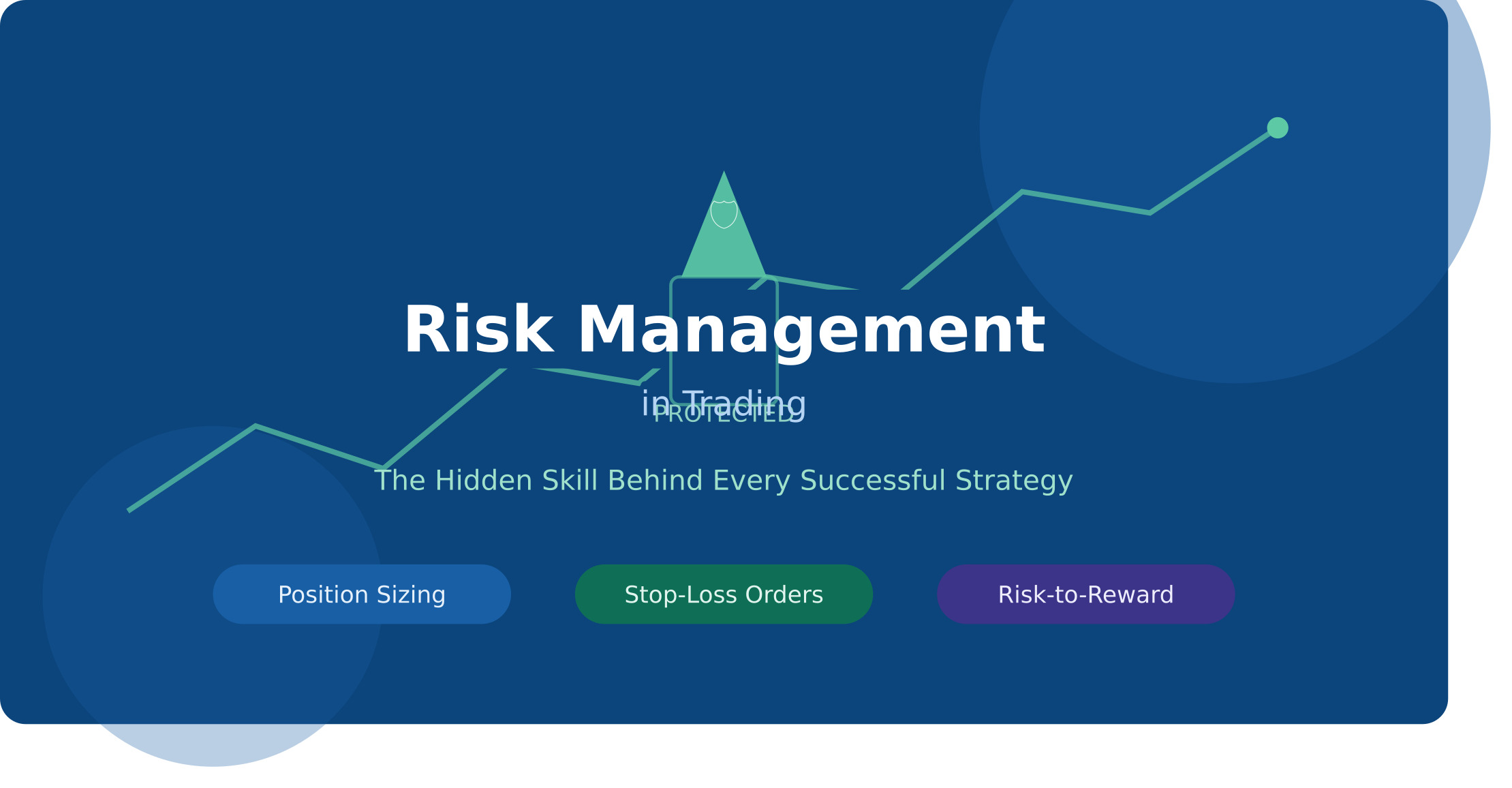
The six elements covered here — position sizing, stop-loss orders, risk-to-reward ratios, diversification, avoiding overleveraging, and understanding volatility — form a complete protective framework for any trader.
Build your risk management plan before you think about profits. Define your rules, write them down, and commit to following them with every single trade. The market rewards discipline, not courage.
Your capital is your lifeline. Protect it first. The profits will follow.
FAQ
What is risk management in trading?
Risk management in trading is the process of controlling potential losses using tools like stop-loss orders, position sizing, and risk-to-reward ratios to protect trading capital over time.
How much should I risk per trade?
Most professional traders recommend risking no more than 1–2% of your total trading capital on any single trade to survive losing streaks without major drawdown.
What is a good risk-to-reward ratio?
A minimum of 1:2 is considered solid — meaning you aim to gain at least $2 for every $1 risked. Many traders prefer 1:3 for a stronger edge.
Why do traders fail at risk management?
Most traders fail due to emotional biases — fear, greed, and revenge trading — that cause them to abandon their plan exactly when discipline matters most.
Is diversification important for traders?
Yes. Spreading exposure across uncorrelated assets prevents a single losing sector or position from destroying your overall account performance.
What is the 1% rule in trading?
The 1% rule states you should never risk more than 1% of your total account balance on a single trade, limiting potential loss per trade to a manageable amount.
How does leverage affect risk?
Leverage amplifies both gains and losses. Overleveraging is one of the leading causes of blown accounts, especially for new traders facing volatile market conditions.
Disclaimer
This article is for educational purposes only and does not constitute financial or investment advice. Trading involves substantial risk of loss. Always consult a licensed financial advisor before making any trading decisions. Past performance is not indicative of future results.